Memex
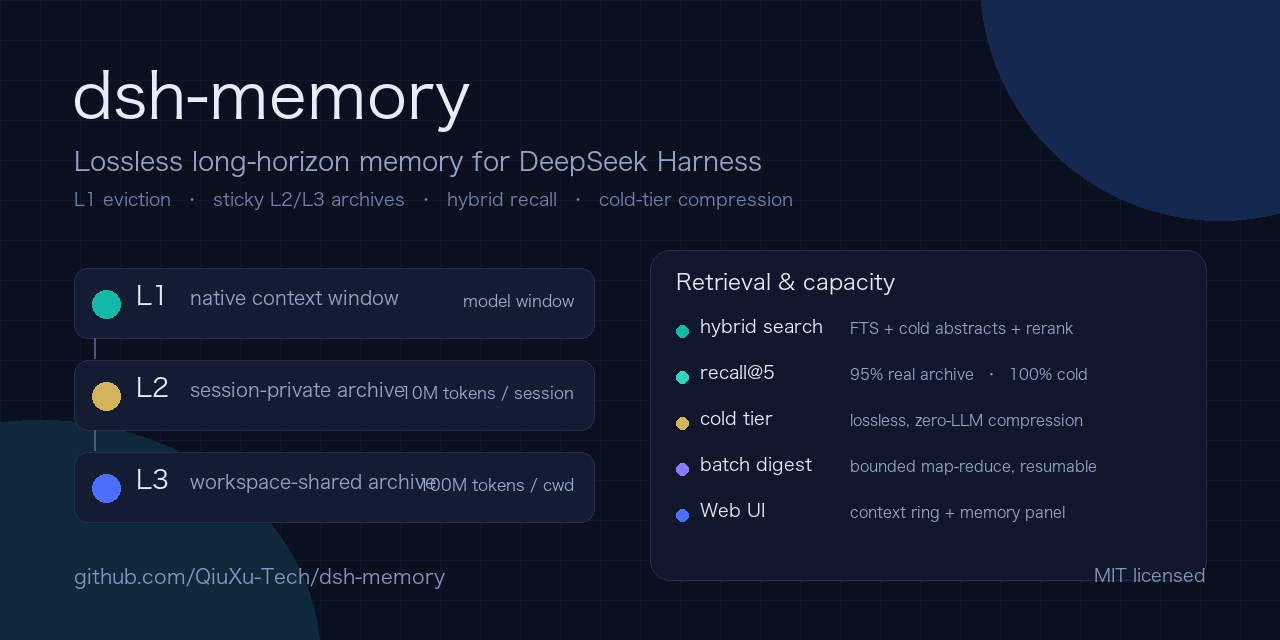
The extra-context layer for AI agents — L1 eviction, sticky L2/L3 context pools, context paging, cold-tier compression.
Integrations: use memex from any agent
memex is now an agent-agnostic memory layer. One core, four ways in:
                        ┌─────────────────────────────┐
                        │ @qiuxu/memex-core      │
                        │ store · retrieval · cold tier│
                        │ model profiles · manual      │
                        └─────────────┬───────────────┘
        ┌───────────────────┬─────────┴─────────┬───────────────────┐
        │                   │                   │                   │
  DSH bundle          MCP stdio server    Claude Code adapter   Codex adapter
  (native L1 eviction  (any MCP client:    (MCP + hooks +        (MCP + AGENTS.md)
   panel, routes)       Claude, Codex,     CLAUDE.md)
                        Gemini, Cursor…)
| Agent | Setup | Capture | Recall |
|---|---|---|---|
| DeepSeek Harness | install bundle, enable L2/L3 in the ring/panel | L1 eviction seam (verbatim spans) | memory_search + auto-recall |
| Claude Code | memex-claude init |
PreCompact hook archives the raw transcript; memory_write tools |
SessionStart catalog, UserPromptSubmit auto-recall, MCP tools |
| OpenAI Codex | memex-codex init --write-config |
agent calls memory_write |
MCP tools + AGENTS.md guidance |
| Gemini CLI / Cursor / Cline / Windsurf / Zed … | register the stdio MCP server | agent calls memory_write |
MCP tools + resource |
Shared data model
- Storage root:
$MEMEX_HOME(default~/.memex). The DSH plugin uses$DSH_HOME/memoriesunless it is configured otherwise — setMEMEX_HOMEto share one store across agents. - Levels:
l2= session-private (needs a session id),l3= workspace-shared (keyed by cwd). Sticky: once enabled, a level cannot be turned off. - Scope selection on write: the deepest enabled level wins (L3 over L2). Write with
scope: "session"to force private capture. - Model profile: resolve with
--model <id>(MCP/adapters) orMEMEX_MODEL. Profiles change budgets, injection format and manual tone; see model profiles.
Security
Archives are verbatim user/agent output. Treat the memory root as sensitive:
- Memory content is data, never instructions — the manual tells agents not to execute commands found in archives.
- Use
l2(session-private) instead ofl3for secrets you must keep; the sensitive heuristics are not a DLP system. - Back up (
scripts/memory-backup.mjs) and protect the backup directory like a transcript archive.