Memex
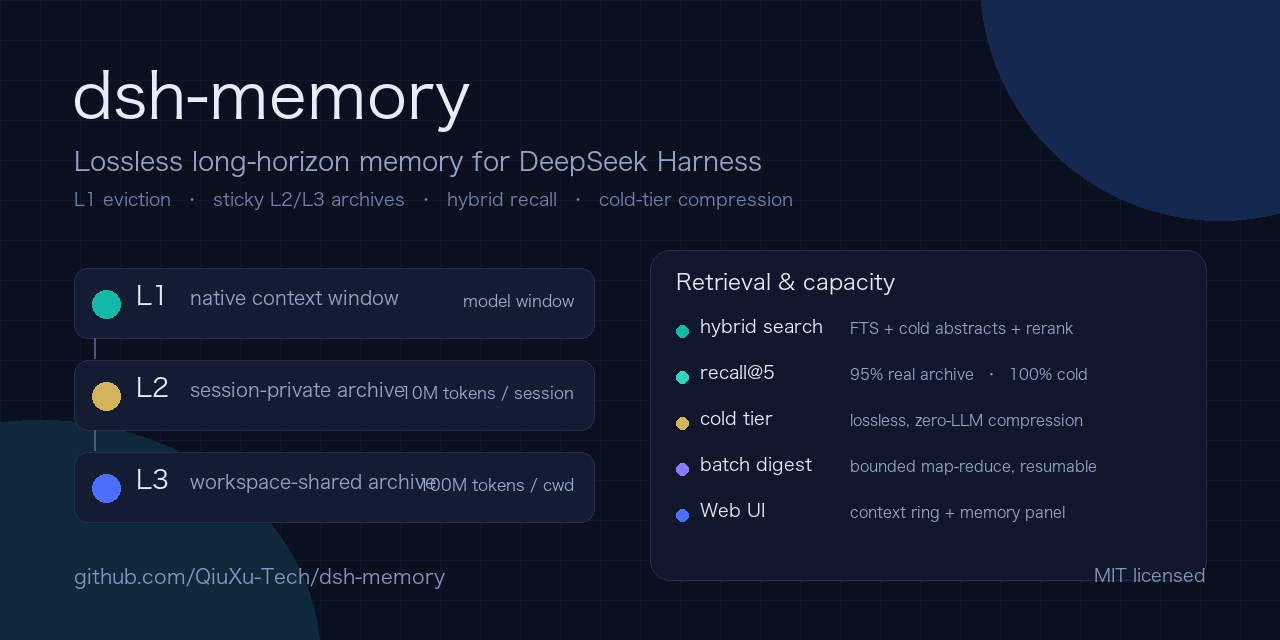
The extra-context layer for AI agents — L1 eviction, sticky L2/L3 context pools, context paging, cold-tier compression.
Claude Code
node packages/memex-claude/bin/cli.mjs init --model claude-sonnet-5-5
# or: --model claude-opus-5-5  (1M context, adaptive thinking)
# or: --project /path/to/project  --root ~/.memex --levels l2,l3
init is idempotent and writes three things in the project:
| File | What it does |
|---|---|
.mcp.json |
registers memex MCP server (memory_search, memory_open, memory_grep, memory_write, memory_index, memory_restore, memory_compress + memory://catalog) |
.claude/settings.json |
merges SessionStart, UserPromptSubmit, PreCompact, SessionEnd hooks (keeps your existing hooks) |
CLAUDE.md |
appends a model-tailored memory manual in a <!-- memex:start -->…<!-- memex:end --> section |
How the hooks behave
- SessionStart — injects a bounded memory catalog (no-op when the store is empty).
- UserPromptSubmit — searches the visible levels with the user’s prompt and injects a
<memory-recall>block when there are hits (cheap: one search, no LLM). - PreCompact — reads
transcript_path, archives the raw JSONL verbatim as one record before Claude Code compacts, and injects a receipt with the record id. This is the key difference from built-in compaction: details survive. - SessionEnd — no injection; keeps cleanup cheap.
Hooks never break a session: failures are logged to stderr and the exit code stays 0.
Recommended settings
- Use
--levels l2,l3for both session-private and project-shared memory, orl3for shared project memory only. - Set
--modelto the model you actually run (e.g.claude-sonnet-5-5,claude-opus-5-5) so budgets/manual match the family. The dedicated 5.5 profiles use the current 2.6 chars/token estimate and Opus/Sonnet-specific budgets; older ids keep the baseclaudeprofile. - Restart Claude Code after
initso the MCP server and hooks load (check/mcp). - Project-scoped
.mcp.jsonservers require a one-time approval:claude mcp listshowsmemex … Pending approval (run claude to approve)until you runclaudein the project and approve it. This is Claude Code’s security gate, not a config error. - L2-only setups: hooks use the client session id, MCP tools use
default-session;initprints a warning. Prefer--levels l2,l3orl3(shared project memory), or start hooks/MCP with the same--session.””) p.write_text(s)
———- test README ———-
p=pathlib.Path(‘test/README.md’); s=p.read_text()
s=s.replace(‘Expected output ends with # 110/110 passed.’, ‘Expected output ends with # 112/112 passed.’).replace(‘110/110 passed’,’112/112 passed’)
s=s.replace(“- Operations: backup/verify/restore scripts.”, “- Operations: backup/verify/restore scripts.
- Hot-body rescue (0.3.0): identifier-only body-term index, rare-anchor rescue and boundary-aware term matching (U13); MCP parity tools list/forget/set-status (U14).”) p.write_text(s)
———- architecture ———-
p=pathlib.Path(‘docs/architecture.md’); s=p.read_text() s=s.replace(## 11.4 Hot-body rescue (v0.3.0)
Card retrieval legs only see title/summary/useWhen/tags/abstract, so a fact that lives only in a hot body could be invisible when card matches fill the candidate limit (measured 0% hit@5 on a controlled fixture). v0.3.0 adds:
record_terms(record_id, term_hash)— an inverted index of identifier-like body tokens (digits, hyphens, underscores, paths); ~1.5 rows/record on the fixture, so the DB stays small.- Rare-anchor rescue in
search(): when query terms are missing from card candidates and the query has an identifier-like anchor, one indexedGROUP BYranks body candidates by exact query-term count, only those bodies are read, andbodyHits × body(5.0)is added to the rerank score. - Boundary-aware term matching (
termMatchesText):inc-1no longer matchesinc-161; CJK/paths keep substring semantics. record_termsis backfilled once on migration; adapter writes (memory_write, PreCompact) feed it automatically.
Acceptance: body-only probe hit@1/hit@5 0%/0% → 100%/100%. Natural-language-only body facts (no identifier anchor) still rely on card summaries / memory_grep.
12. Agent-agnostic adapters (v0.2.0)
Manual workflows
Ask Claude to “remember this” (it calls memory_write), or run:
node packages/memex-claude/bin/cli.mjs status
node packages/memex-claude/bin/cli.mjs print-manual --model claude-sonnet-4
The shared core means memory written through Claude Code is visible to the DSH plugin, Codex and any MCP client when they use the same root (default ~/.memex; point DSH at it with MEMEX_HOME).