Memex
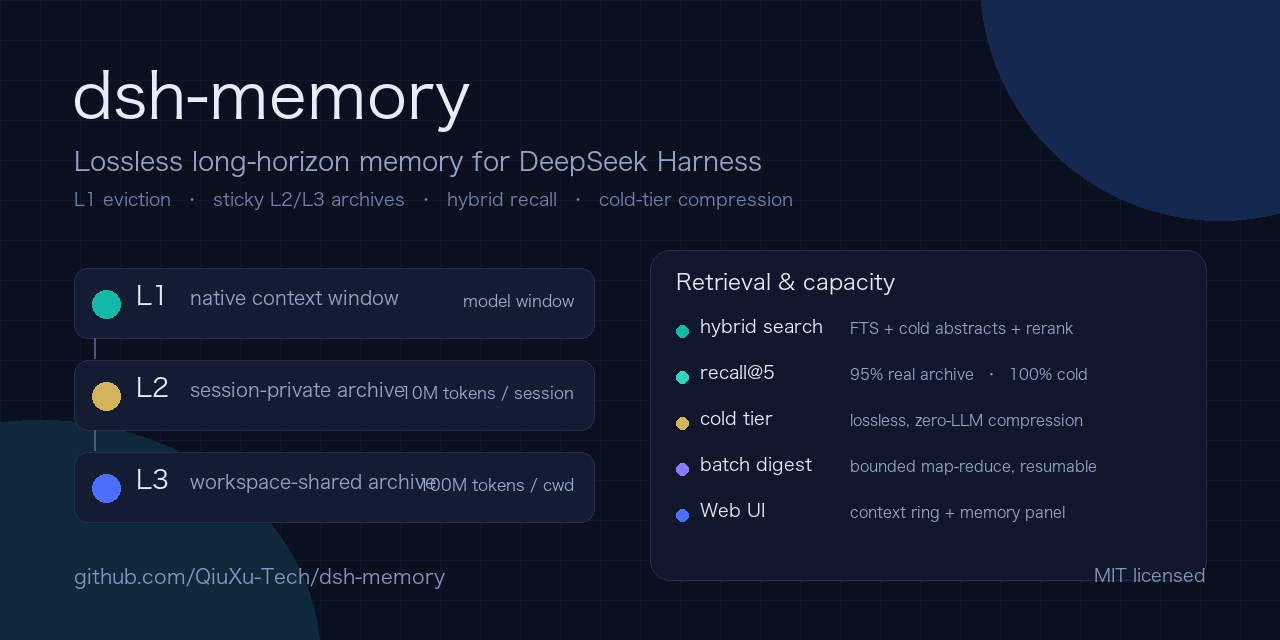
The extra-context layer for AI agents — L1 eviction, sticky L2/L3 context pools, context paging, cold-tier compression.
Two additional ESLint agent tasks registration
Registered before these solver calls, after earlier instrumentation results and a gateway disconnect were observed. The two newly selected open, accepted issues are ESLint #21441 and #19931. The manifest has SHA-256 22beca282d421dc1a84571175228e553c1bd1074de7f7288666f3ab992f6587c. Complete available issue discussions were captured before this batch, and source is pinned to 12cbff4125db3f6446f72fa0c48c46b92b120427 with Node 24.18.0. Selection occurred after examining previous batches, so it is not an independently preregistered component of a 30–50-task study.
For #21441, uncached controls pass while two option-toggle sequences produce stale results on the original source. A reference using source changes from PR #21448 passes both issue checks and additional cache-reuse and configuration-invalidation controls. For #19931, the original fails the requested finally-case autofix check. A narrowly restricted reference passes the issue case and controls for lexical scope and comments. When evaluated separately, the source change from PR #20745 did not pass these controls: on one input it generated a duplicate lexical declaration; another reference variant removed a catch comment. These observations concern the inspected patch on the pinned checkout, not a merged release or a judgment by the upstream project. The limited reference leaves those cases unmodified. Of 16 original rule-test expectations, one expected no autofix in the precise finally case now requested; it is explicitly skipped in the regression comparison and the other 15 pass on both baseline and limited reference. The acceptance checks independently exercise the newly requested behavior. These controls are incomplete and do not establish maintainer acceptance.
Paired keyword-versus-Memex assignments, isolated source copies, bounded read/edit tools, randomized order, AI blind review and disagreement handling follow the search-repair follow-up. The new worker permits read-only access to upstream tests and searches source files up to 1.5 MB. Agents get up to 16 model turns and one tool-free final response at the cap. The hidden acceptance and regression scripts are fixed by hash, and test dependencies are installed separately after the agent stops. The cache task’s additional regression controls are custom; the catch task uses the upstream rule suite with the one explicitly documented changed expectation skipped.
Provider errors, ambiguous charges, invalid reviews and unattempted assignments remain recorded; calls are not automatically retried. Each stage stops scheduling after its first provider error or missing usage. This small, post-observation convenience batch cannot establish a production correctness increase, cost saving, independent human acceptance or autonomous memory management. Costs include a target under $1 for this batch but no guaranteed hard cap; provider reconciliation and all missing costs must be reported separately.