Memex
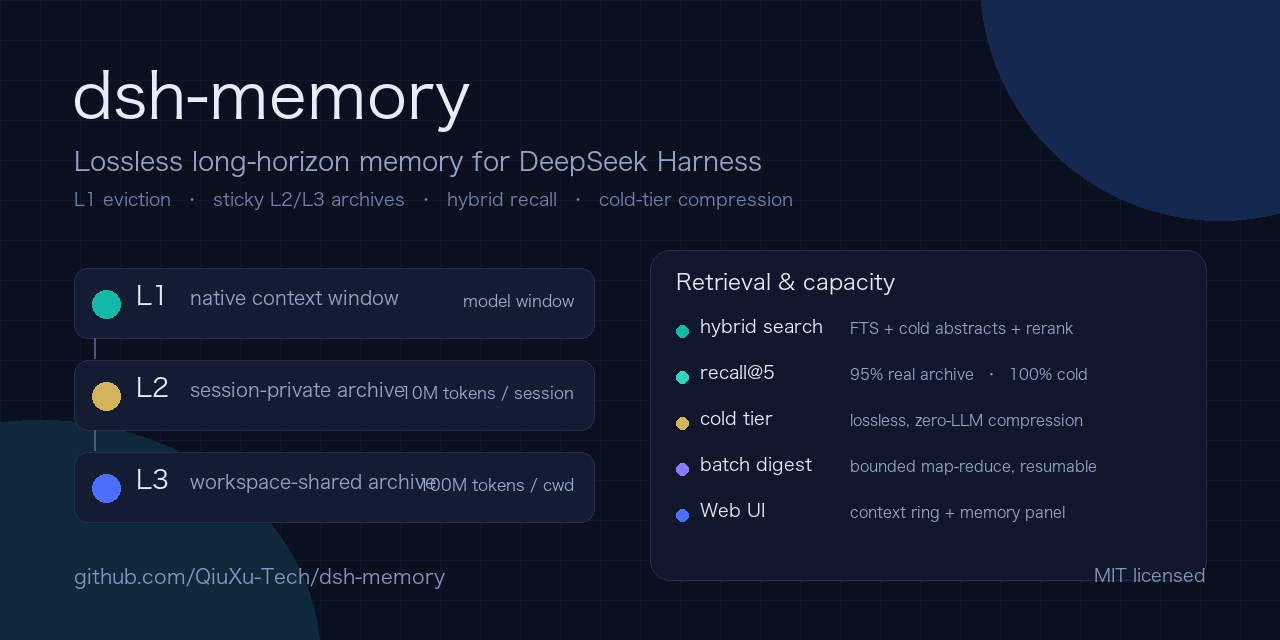
The extra-context layer for AI agents — L1 eviction, sticky L2/L3 context pools, context paging, cold-tier compression.
Two Lodash issues — registered instrumentation
Registered before these solver and review calls. Two previously unattempted open Lodash issues, complete discussion snapshots, fixed checks and randomized paired order are bound by the manifest, SHA-256 c6fae63083372c808c78a1da2e8072ffaf2a63c3eea0793e118b4c77320ea41d. Selection followed prior outcomes; shared repository and public source exposure limit independence.
| Issue | Frozen acceptance | Source-only reference |
|---|---|---|
| #6191 | Deep cloning sparse arrays preserves holes and explicitly present undefined entries while cloning nested objects; dense arrays remain valid. |
PR #6262 |
| #5948 | Picking a path through a numeric-key object preserves the object container, while picking through an array preserves the array; ordinary picks remain valid. | PR #6298 |
No-history negative control: #5948 had zero public discussion comments at snapshot time. Both arms receive no historical records, though their empty-result messages differ. Its results cannot establish a retrieval or memory effect, and condition identity may be inferred from formatting. #6191 has only two short comments, one quoting the issue. These are not long production sessions.
The qualification ledger records baseline failures and source-reference passes for public and acceptance checks, with controls passing on both. These narrow checks are not upstream acceptance; public discussions and PRs can disclose solutions or appear in model training. The pinned lodash.js source is loaded directly without npm dependencies.
The VM, paired randomization, bounded tools, rubric, model budgets and logged 503-only retries follow the validator registration. No timeout is retried; provider failure or missing usage stops each stage. The registered AI adjudicator has the same model name as the solver, was selected after previous failures, and is not independent. All AI names share one proxy with unverified provenance. Estimated model-call target is below $1, not a hard cap. These results do not establish production effectiveness, savings or autonomous memory management.