Memex
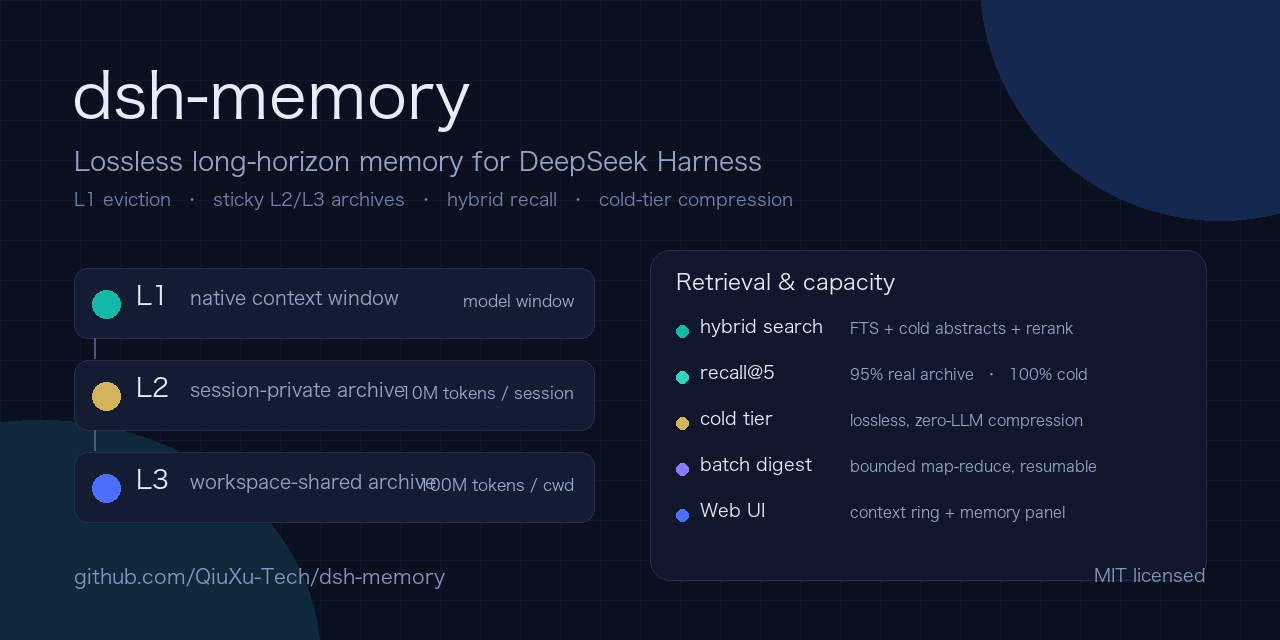
The extra-context layer for AI agents — L1 eviction, sticky L2/L3 context pools, context paging, cold-tier compression.
Two validator.js issues — registered instrumentation
Registered before these solver and review calls. Two previously unattempted open validator.js issues, complete discussion snapshots, checks and randomized paired order are bound by the manifest, SHA-256 58a4537aca3557a1e8f70e3a143915e14b3a9e3d209596c792e9b90046d30ae0. Selection followed prior results. The two tasks share a repository and are not guaranteed independent; the separate adaptive registrations are not one pre-registered 30–50-task cohort.
| Issue | Frozen acceptance | Reference |
|---|---|---|
| #2295 | Unknown hash algorithms throw by default and return false with validateAlgorithm: false; known algorithms and invalid input controls remain valid. |
Source-only PR #2843; the default follows the issue discussion. |
| #1309 | With allow_exponential: true, the issue’s decimal and a second exponential example pass, malformed multiple-exponent strings fail, and ordinary/default decimal controls remain valid. |
Source-only PR #1750 plus a manual rejection of multiple e separators. The original PR source failed that acceptance check; both patch versions are preserved. |
The qualification ledger records baseline failures and selected source-reference passes for public and acceptance checks, with controls passing on both. Checks are partial and not maintainer acceptance. Node module hooks load the pinned source without npm dependencies; this is not the distributed package. Public discussions and PRs can disclose solutions or appear in model training.
The randomized paired arms, bounded tools, reviewer rubric and 503-only retry policy follow the previous registration. No timeout is retried; provider failure or missing usage stops the stage. After repeated Gemini truncation, the registered adjudicator is gpt-6-astra at 700 output tokens; this is the same model name as the solver, selected after earlier failures and not independent adjudication. deepseek-flash and qwen3.8-flash remain the blinded reviewers; all names share a proxy with unverified provenance. Estimated model-call target is below $1, not a hard cap. Short seeded issue histories do not establish production effectiveness, savings or autonomous memory management.