Memex
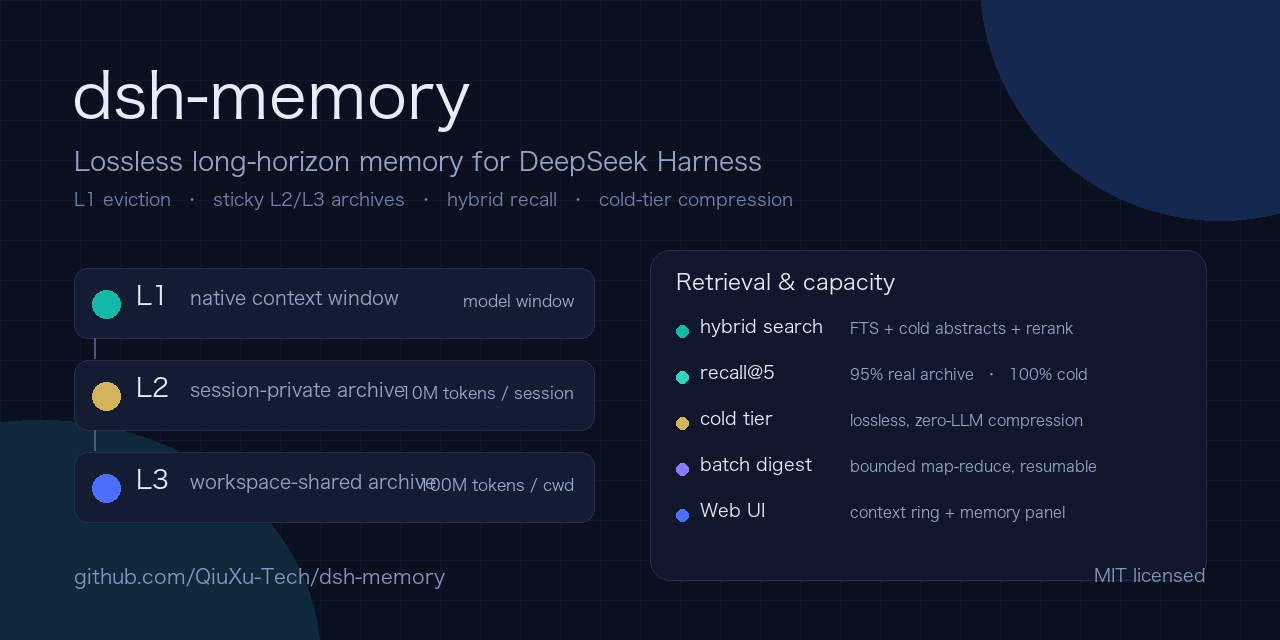
The extra-context layer for AI agents — L1 eviction, sticky L2/L3 context pools, context paging, cold-tier compression.
Alternate-solver follow-up after timeouts
Registered after two earlier solver requests timed out, but before these task calls. The manifest has SHA-256 759f2b1c143503962658c936b5a39a9c00a26f81270a7a34b8bef73346d1c18e and fixes the new randomized paired order, issue snapshots, checks and runner. This follow-up is not part of a single pre-registered 30–50-task cohort.
Four issues, #20306, #20307, #10851 and #12649, were registered earlier but neither arm was started after their respective batches stopped. Their frozen issue and regression checks remain exactly those in the four-issue registration and three-issue registration. The interrupted #21422 and #18080 assignments are not retried. #20307 shares a reference patch and may share a cause with #18080; these are not independent samples.
The fifth issue, #8182, is newly selected. Its frozen issue check requires the two reported GraphQL descriptions with one or two following comments to retain their requested exact formatting and remain idempotent. The pinned baseline fails both; a locally ported source-only reference, uncompressed SHA-256 d097abb4391101df6f03b821a07b5465702782bcd6820aa13b8f9f8fd031ebd6, derived from open PR #14838, passes. Three small ordinary GraphQL regression controls pass on baseline and reference. The port adapts old source paths and places the handler in an existing file; it is not a merged upstream change or a full project suite.
gpt-6.1-sol is used as solver after an independent single-call tool-route probe and a five-call synthetic edit/test diagnostic succeeded. Those diagnostics are not real task outcomes. The reviewer pair is deepseek-flash and gpt-6-astra, and the adjudicator is the solver model gpt-6.1-sol. All are AI models, so this is neither independent human review nor a randomized solver comparison. The alternate solver and review pair were chosen after observing timeouts; failed requests and any unreported fees remain UNKNOWN. The explicit rubric, bounded tools, 12-turn limit, isolation, per-stage stopping rule and no automatic retry follow the mixed batch protocol. The estimated batch target is below $1.50, not a hard cap.
Public PRs, short issue discussions, partial tests, possible model exposure and the post-observation change of solver limit interpretation. #20306 supplies only one discussion comment to each condition. No production correctness, cost-savings or autonomous memory-management conclusion follows from this batch.