Memex
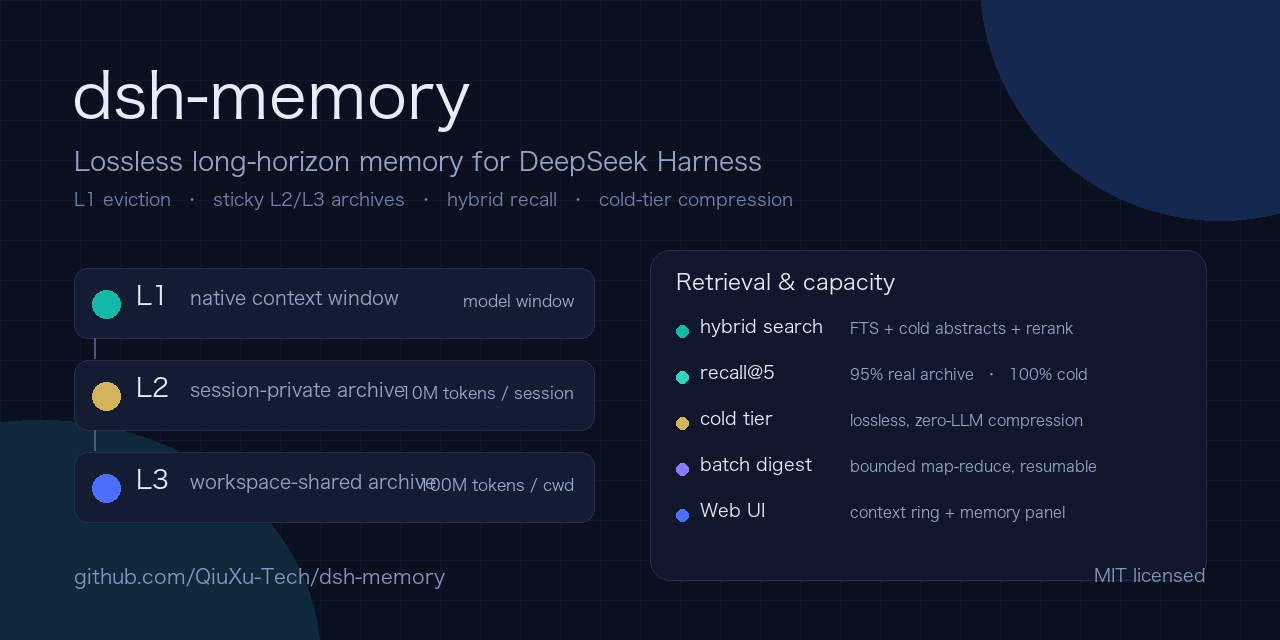
The extra-context layer for AI agents — L1 eviction, sticky L2/L3 context pools, context paging, cold-tier compression.
Prospective engineering canary registration
Registered before model trial calls. This is one selected, isolated engineering canary, not the planned 30–50-task production study. The private manifest SHA-256 is 0b60cf77b431d5ab4f0630021a9ffe722be7829819a43ab87ba3d1ddba97657d; the fixed validator SHA-256 is a766515938d326b53750db215103b0c8b171d23ba198b07dd92798caf06e7475. The task is lodash/lodash#5610 at source commit 2b5e6f7399a7b48005140b5d5c6bc6c0e62919a8; Memex is based on c5a54f0457733c9c3f84b8d1d19d21e172c11cd0. The public issue and its five comments were captured before trial calls. The issue was manually selected because the reported failure reproduced. The operator has already constructed a passing positive-control reference, so this is not a blinded task selection or held-out problem.
The three paired conditions have the same issue body and fixed code excerpts: no discussion history; automatic keyword retrieval from the five public comments; and the real Memex pager over the same comments. The keyword condition opens up to three hits; the pager uses its existing 1,800-token budget and 400-token page cap. Seed 20261031 gives execution order Memex, no history, keyword. These comments are real issue discussion, not a long real conversation; the pager is pre-seeded and this experiment cannot validate autonomous memory management. Supplying the relevant source locations and restricting the patch to one function makes this a narrow controlled repair, not general agent task execution.
Claude Haiku 4.5 proposes at most one patch per condition using at most 1,000 output tokens. Patches are confined to one return expression, applied to isolated copies, and evaluated with the same frozen regression checks. The baseline check fails on the pinned upstream code; a separately constructed positive reference passes. These checks are partial and do not imply upstream project acceptance. Run no patch against the upstream project or submit it to GitHub.
Two blinded AI reviewers (DeepSeek Flash and GPT-6 Astra) score correctness and side-effect risk separately, with null for insufficient evidence. If both return valid, different ratings, Claude Haiku is the adjudicator; it is also the solver, so this adjudication is not independent. Reviewer prompts cannot guarantee that candidates conceal their condition. These are machine reviews, not human annotations.
At most three solver calls, six reviewer calls and three disagreement adjudications are planned; no failed call is automatically retried. Solving stops after a gateway failure; any reviewer stops after its first gateway failure. An empty, truncated, invalid or missing response remains missing, not a success. Gateway request counts, byte sizes, usage, timestamps, failures and candidate billing matches will be retained. Historical gateway diagnostics and their candidate-matched charges remain separate. Actual provider charges are reconciled only where evidence supports them; missing or unmatched entries remain UNKNOWN. The initial combined study target is under $5, subject to provider metering and delayed or unavailable billing; it is not a guaranteed hard spending limit.
The experiment cannot establish a causal production improvement, cost saving, independent human acceptance, default-policy choice, or dependable memory autonomy. The larger prospective study requires new eligible tasks, independent predeclared outcome checks, a defensible design and an agent-capable isolated execution environment. The sandbox used here denies network and file writes, restricts selected host reads and has a timeout; it has not been independently certified as a comprehensive security boundary.