Memex
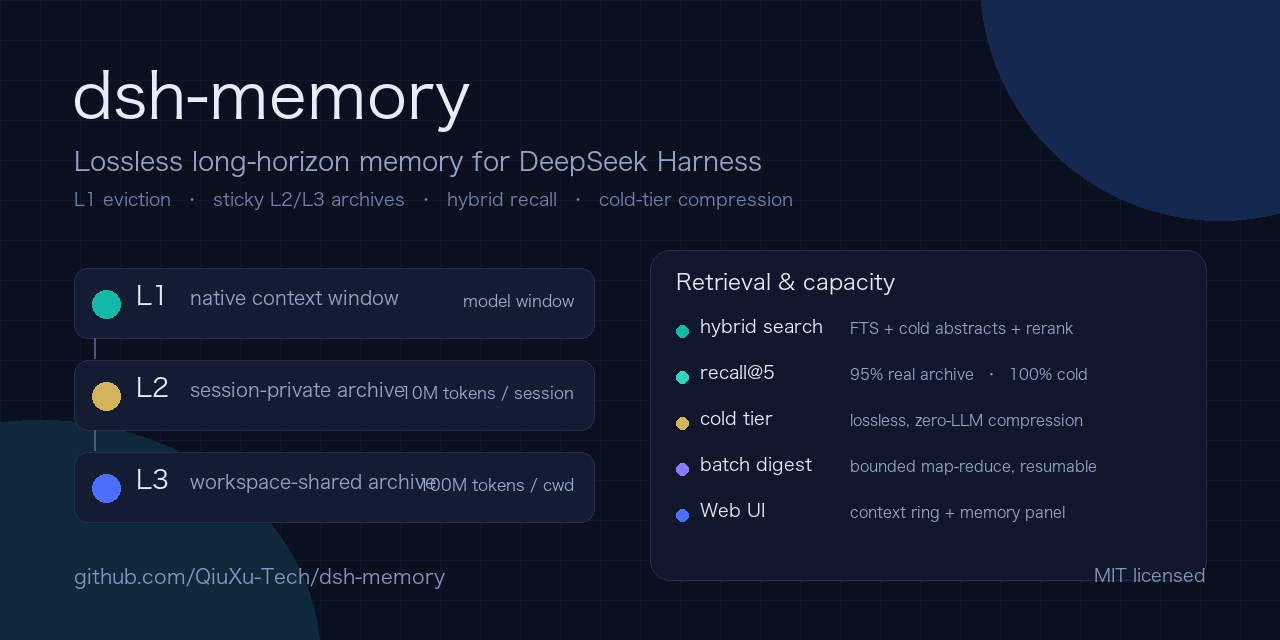
The extra-context layer for AI agents — L1 eviction, sticky L2/L3 context pools, context paging, cold-tier compression.
Post-hoc explicit-rubric AI re-review registration
Registered after observing the initial batch results, but before these re-review calls. Earlier reviewer prompts specified scores in 0, 1, 2 or null without defining the direction of the numerical scale. Their original responses and format-validity records remain preserved; their scores must not be pooled or interpreted as a common numerical scale. The separately frozen re-review manifest has SHA-256 fe39b7462fc05e7da2bd6744234aab2eaee4b5b71ddff6235ecd120b4e5a6982.
This re-review selects the six attempts from batches 1–5 with a nonempty code diff. It does not review unchanged or interrupted attempts and therefore cannot represent all assigned tasks. The candidates receive fresh blinded identifiers; the private manifest binds the packets and mapping by hash while public candidate/result hashes permit identity checks. Blindness is not guaranteed if a candidate’s own evidence reveals its experimental condition.
Correctness means: 0 = the change does not resolve the issue or is demonstrably wrong; 1 = partial or plausibly useful but insufficient; 2 = the supplied evidence supports the requested behavior. Side effects mean: 0 = a concrete serious regression is demonstrated; 1 = plausible risk or material uncertainty remains; 2 = no material regression is identified in the supplied evidence. null means the evidence does not support a score. These are AI opinions about partial evidence, not maintainer acceptance.
Every candidate is reviewed by deepseek-flash and one other AI model distinct from the solver family. For gpt-6-astra solver attempts, gpt-6.1-sol replaces the earlier claude-haiku-4-5 reviewer because that earlier route returned empty outputs; for Haiku solver attempts, the second reviewer is gpt-6-astra. A disagreement between two valid reviews receives a further AI assessment by the solver model family, so adjudication is not independent human review. Missing, invalid, and failed assessments remain missing. The script stops launching requests within a stage after the first provider error, malformed response, or absent token usage; it does not automatically retry. Usage and fee gaps remain visible.
This is a post-hoc correction and model substitution, not the original planned assessment or a basis for replacing missing original results. Public issue and PR exposure, partial checks, a small selected sample, model correlation, and unverified reviewer reasoning limit interpretation. It cannot establish a production effect or savings.