Memex
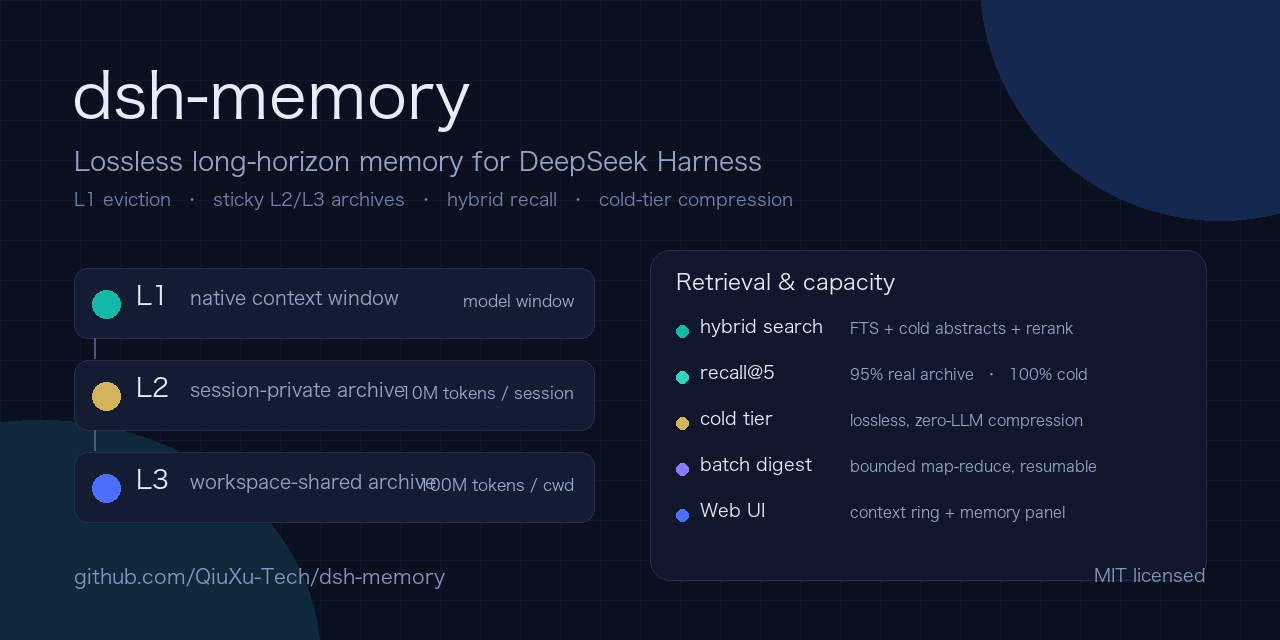
The extra-context layer for AI agents — L1 eviction, sticky L2/L3 context pools, context paging, cold-tier compression.
Three-issue Lodash agent instrumentation registration
Registered before this batch’s solver and review calls, but after observing the earlier ESLint instrumentation results. It is a separate three-issue exploratory batch, not a preregistered 30–50-task study. Its manifest has SHA-256 f1361c40f592f28fbba709e214c5a08d3cae594ad280bc7e4f765b8ab1984ebd. The new issues are lodash #6195, #5881, and #5750. All were open, labelled bugs and captured with all currently returned comments before solver calls. The pinned source is 2b5e6f7399a7b48005140b5d5c6bc6c0e62919a8 and the isolated VM uses Node 24.18.0.
Each frozen issue-specific acceptance check fails against that source and passes a reference modification. The references for #6195 and #5881 use only the relevant source changes from public PRs #6201 and #6241; the reference for #5750 ports the regex change from #5886 to the pinned source. Additional hand-written ordinary-behavior controls pass on both the original and the reference. These controls are not the full upstream Lodash suite, and neither a reference pass nor the labels prove acceptance by maintainers. Public discussion and PRs may be present in model training, and an issue comment includes a possible workaround.
As in the earlier batch, each issue is paired across independently isolated copies with randomized task and arm order, comparing the same keyword baseline with the real Memex pager over the captured issue discussions. The source tools, model, budgets, issue text and public tests are equal between arms. Discussion contexts differ by retrieval and are short, pre-seeded issue history, not a long production session or autonomous memory lifecycle. The two projects and batches are separately selected and cannot support a population-level effect estimate.
Following the first batch’s observed tool limitations, the new worker allows read-only access to upstream tests while prohibiting their edits. It exposes the 150-line read maximum in the tool schema. A run has up to 16 model turns with at most four tool calls per turn; if it reaches that limit, one additional tool-free final response is requested with a 700-token cap. These changes were made before this batch’s assignments, and do not rewrite the earlier results. Source modifications remain bounded exact replacements, and arbitrary shell or network tools are unavailable. Targeted boundary tests passed in the isolated VM; this does not constitute a sandbox certification.
The issue-specific acceptance check and separate custom regression controls run after each attempt. A successful instrumentation result requires a nonempty complete final response and both sets of checks to pass. Two AI reviewers independently see anonymous attempts and partial checks, with a structured 0–2 or UNKNOWN rubric; an AI adjudicator using the solver’s model family addresses disagreements between two valid scores. Empty or malformed reviews, failed calls and incomplete attempts are retained. The reviewer JSON example now names the exact allowed evidence labels, but labels alone do not verify the truth of a claim. Condition identity may remain inferable from an answer or patch.
The scheduler stops launching calls within a stage on the first provider error, malformed response or missing token usage; there is no automatic retry. The batch cost target is under $1 and is not a guaranteed hard spending cap. All reported tokens, candidate-matched provider rows, unreported usage and other missing costs will be separated. This sample cannot demonstrate production correctness, cost savings, human acceptance, or reliable autonomous memory management.