Memex
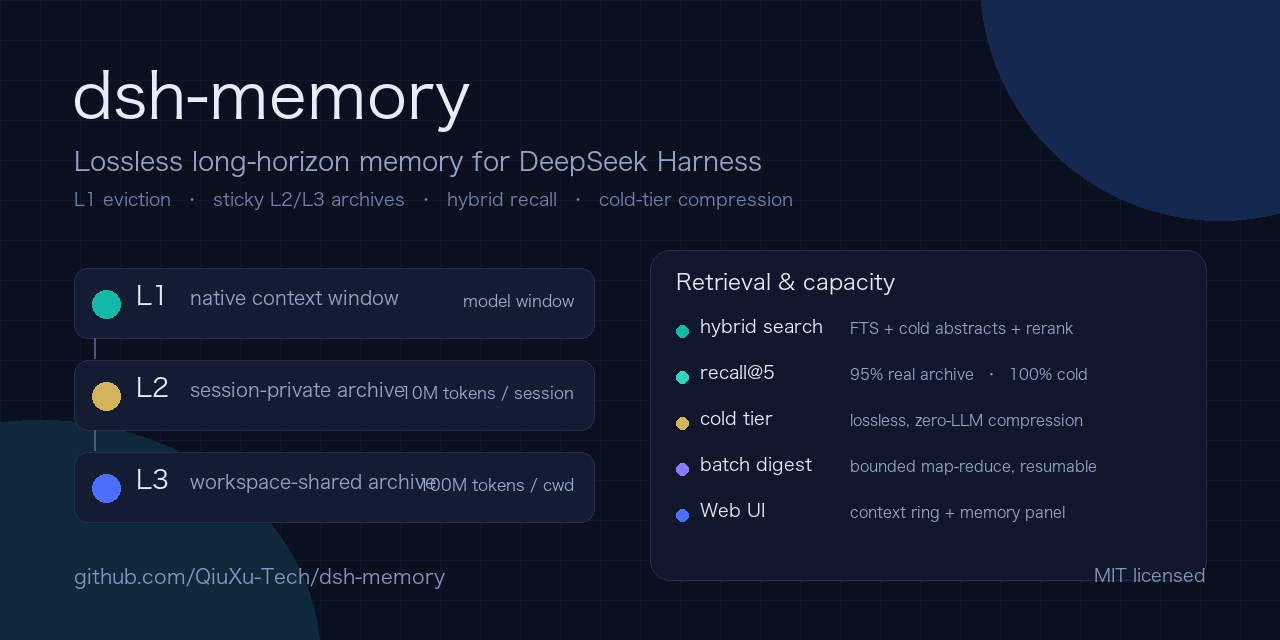
The extra-context layer for AI agents — L1 eviction, sticky L2/L3 context pools, context paging, cold-tier compression.
Two additional Prettier issues — registered instrumentation
Registered before these solver and review calls. Two previously unattempted open issues, their complete discussion snapshots, fixed checks and randomized paired order are bound in the manifest, SHA-256 09fe7d5d262b6de8fd0c3b0beee42588b2be6a4187553225dc1500d24896875f. Selection followed earlier outcomes; these are not part of one independent pre-registered 30–50-task cohort.
| Issue | Frozen acceptance | Source-only reference |
|---|---|---|
| #11982 | Escaped + and * in SCSS custom-property references remain intact and formatting is idempotent; controls cover ordinary variables, arithmetic and CSS. |
PR #20212 |
| #16925 | Multiline template literals inside ordered and unordered MDX lists retain their literal whitespace and format idempotently; controls cover ordinary MDX. | PR #20331 |
The qualification ledger records baseline failures and source-reference passes for public and acceptance checks, with controls passing on both. The checks are partial and do not establish upstream acceptance. Public discussions and PRs can disclose solutions or appear in model training; common projects introduce dependence.
The VM, source/runtime, randomized paired arms, bounded tools, rubric, 700/2,048 review-token limits, 2,048 adjudication-token limit, and 503-only retries follow the previous registration. No timeout is retried. The batch cost target is below $1, not a hard cap. A Qwen timeout in another batch has been preserved; successful routing cannot be assumed. Shared-proxy AI reviews and short seeded issue discussions do not establish production effectiveness, savings or autonomous memory management.