Memex
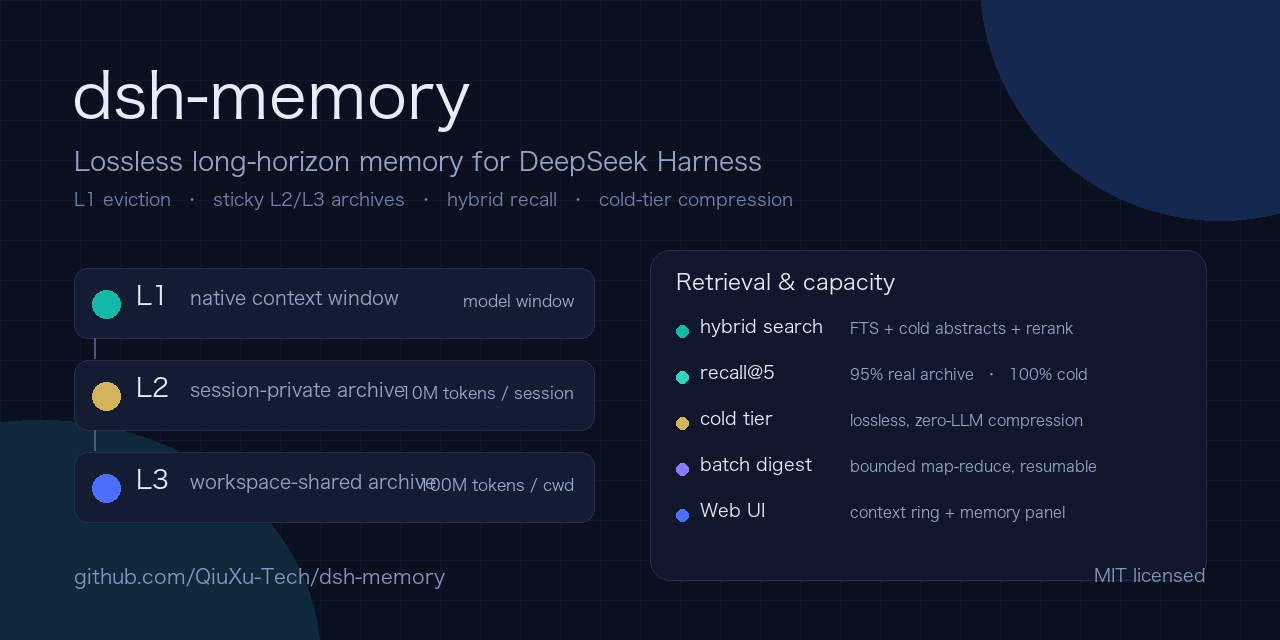
The extra-context layer for AI agents — L1 eviction, sticky L2/L3 context pools, context paging, cold-tier compression.
Two unstarted tasks on a separate model route
Registered after repeated 503 responses on the previous solver route, before these task calls. Both arms of #17213 and #15537 were NOT_RUN_AFTER_STOP in batches 12 and 13, and neither batch’s solver log contains a start event for those four slots. The failed #18066 and #9955 requests are not retried. The manifest has SHA-256 764124b5aea171946f3a4dab92459b863b12aa492c6c2af5b69034c31bf05efa and fixes a fresh paired order.
The source, issue checks, small regression controls and related caveats remain as in the six-issue registration. Both retrieval arms select the same single comment for #17213 and both select the same two comment IDs for #15537. These short contexts do not represent independent long-running production tasks.
The solver is now deepseek-flash, with its thinking mode disabled. A separate four-call synthetic search/edit/test diagnostic passed before registration; that is not a real task outcome or guarantee of availability. The blinded AI reviewers are gpt-6-astra and claude-haiku-4-5; the AI adjudicator is gpt-6.1-sol. These are distinct model names through the same proxy, not independent human assessors. Earlier Haiku reviews returned empty output and the Sol route returned 503; any such failures here remain missing and retain their unknown usage or fee. The explicit rubric, 12-turn budget, isolated tools, stop-on-provider-error within each stage and no automatic retry remain unchanged. The estimated target is below $1, not a hard cap.
This selection and model change follow observed failures, so the batch is not a randomized comparison of solvers or part of one pre-registered cohort. Public source exposure and partial checks preclude a production correctness, cost-savings or autonomous memory claim.