Memex
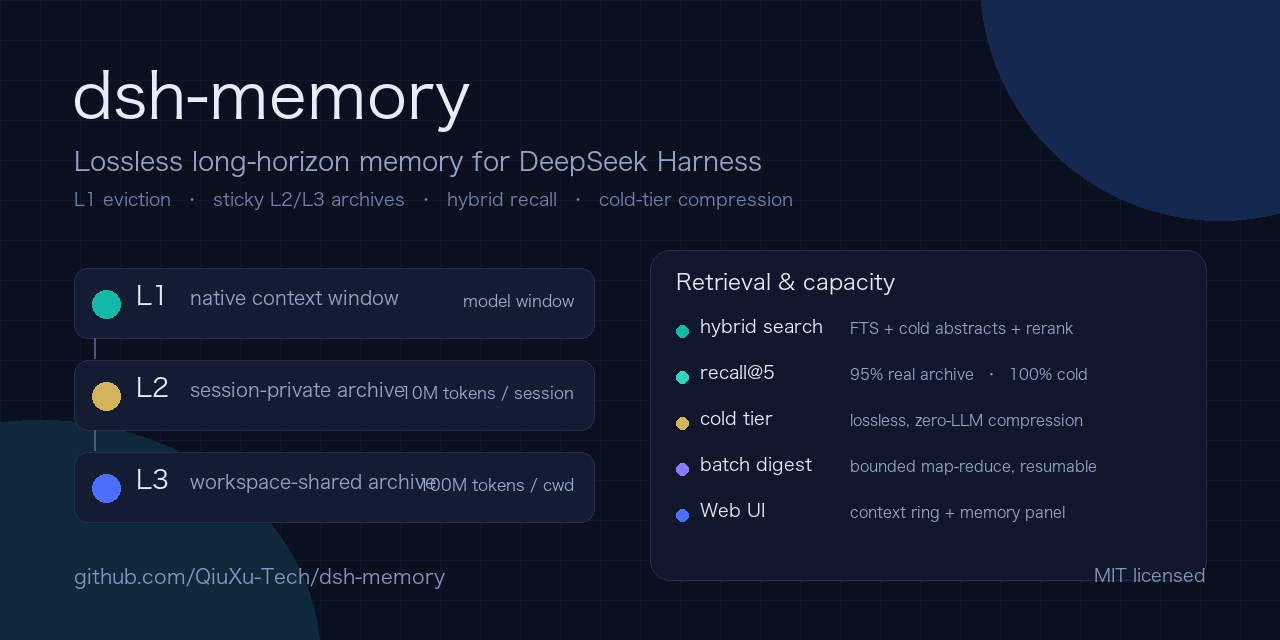
The extra-context layer for AI agents — L1 eviction, sticky L2/L3 context pools, context paging, cold-tier compression.
Three-issue prospective agent instrumentation registration
Registered before the first solver or review call. This is a small engineering instrumentation batch, not the requested 30–50-task study and not a production value estimate. The frozen manifest has SHA-256 6f58b0a8bd29b48b5e17a5279a065754b92603c2749cbb57d9da630671a1a7f5. The three newly attempted issues are ESLint #21333, #21436 and #21443. All were open and labelled accepted at the captured snapshot, and their full issue comments were captured on 2026-10-31 before the solver calls. The pinned ESLint source is 12cbff4125db3f6446f72fa0c48c46b92b120427, with Node 24.18.0. Private captured text and tool traces are retained for authorized audit.
For each issue, the original source failed the issue-specific acceptance check while a reference modification passed it. The reference for #21443 was locally constructed; the other two came from public PRs #21435 and #21446. The unchanged original and the corresponding reference both passed the pinned upstream rule suites: 608 cases for no-invalid-this, 77 for eqeqeq, and 42 for max-statements. These selected checks and reference patches are not independent acceptance by the ESLint project; existing issue discussions and PRs can contaminate models through prior exposure. Acceptance checks and their hashes are in the manifest. A separately considered no-shadow reference changed the outcome of 12 prior upstream expectations; its treatment requires further review and it is not in this batch.
Each task gets two isolated hard-linked source copies. Atomic replacement prevents an edit in one copy from altering the base or the other arm. With the fixed seed in the manifest, both task order and the within-task order of keyword retrieval versus the real Memex pager are randomized. The two conditions use the same solver, tool schema, public test, issue text, round/output limits, and source snapshot; the intervention is pre-seeded issue-discussion context selected by the respective retriever. The keyword arm opens up to three hits, while the pager uses its existing 1,800-token budget and 400-token page cap. Actual contexts and IDs are frozen privately before trial calls. Their content and lengths can differ; this is a comparison of retrieval configurations, not a controlled test of autonomous memory write decisions.
A bounded agent may search/read source, make up to 12 exact replacements, each matching once, and invoke a fixed public example; no arbitrary shell or network tool is available. Solver work stops after eight model turns, with at most four tool calls per turn and 1,000 output tokens per model response. Model-controlled code is checked in a Linux VM with a second, network-disabled unprivileged sandbox, read-only source mounts and bounded resources; targeted boundary checks do not certify the sandbox. Each attempt is independently evaluated after the agent stops using the same frozen issue-specific acceptance check and upstream rule suite. A successful instrumentation result requires a complete final response and both checks to pass. Failures, limits, empty/truncated responses and unattempted assignments remain visible; test or provider errors are UNKNOWN rather than inferred success.
Two AI reviewers receive anonymous candidate outputs, issue text and partial check results, in a separate randomized presentation order. They return 0, 1, 2 or UNKNOWN for correctness and side-effect risk with references to the supplied evidence; malformed, empty and truncated evaluations remain invalid. Only nonempty responses or patches are sent for review. Disagreements between two valid ratings receive one AI adjudication; the adjudicator shares a model family with the solver and is not an independent human. Condition identity can sometimes be inferred from the output despite anonymous labels. These opinions do not establish upstream acceptance.
The scheduler stops launching calls within a stage after a provider error, malformed provider response or missing usage; no failed call is automatically retried. The target is under $1 for this batch, not a guaranteed hard spending cap. Record each attempted request and reported token usage, preserve failed/missing usage as UNKNOWN, and reconcile provider charges only when rows can be matched. Local compute, storage, engineering time, cache pricing and unreconciled/delayed charges remain UNKNOWN.
Three correlated issues from one repository, with short issue discussions and public potential solutions, cannot establish a production improvement, savings, independent human acceptance or autonomous memory management. Future task selection and any larger cohort must be reported separately from this pre-outcome registration.