Memex
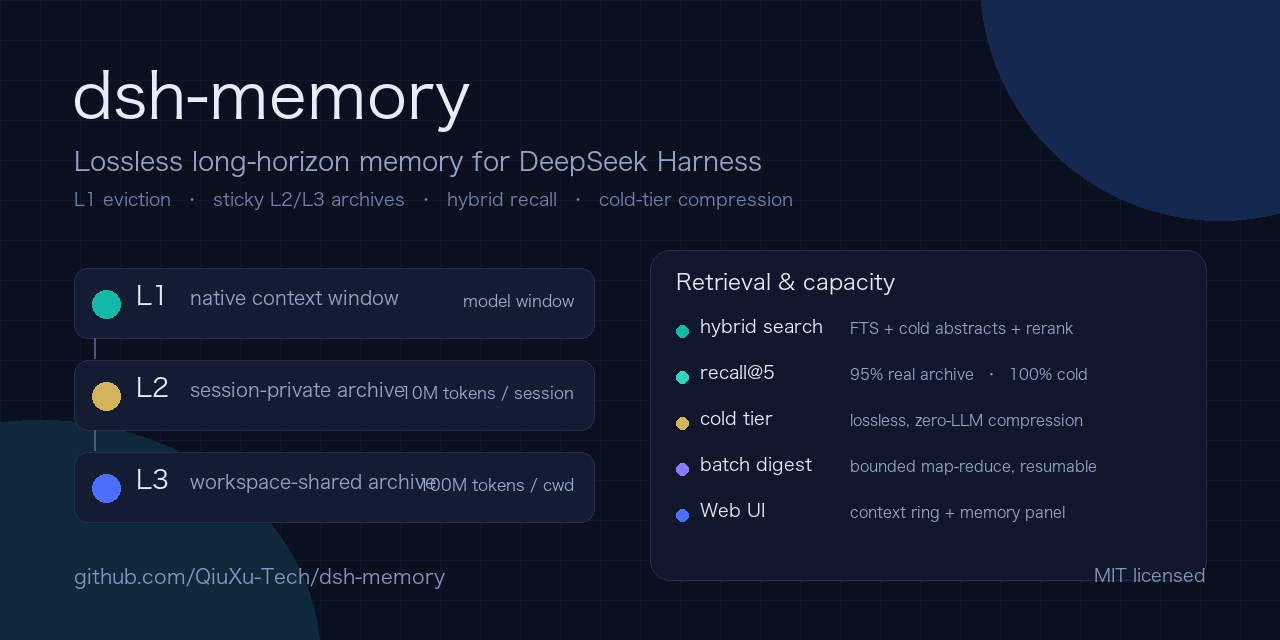
The extra-context layer for AI agents — L1 eviction, sticky L2/L3 context pools, context paging, cold-tier compression.
Follow-up retrospective pilot registration
Registered before follow-up model calls. The private frozen manifest has SHA-256 d89a90955c8d22b930fcd3187d90aa66288c0aca44fe8106d73c8c929d3415f0; implementation and reviewer prompts are pinned to c3f9d97. Source conversations, assignment keys and raw outputs stay private.
Twelve historical questions from six session snapshots are planned, with five conditions each: 60 isolated answer runs. Nine questions are reused from the previous pilot; three newly selected questions come from distinct software-workflow, editorial and website-project conversations. These are convenience-selected, correlated histories associated with one user, not independent users, representative held-out cases or completed production tasks. Each run sees only time-prior clipped archive material and recent history; some historical summaries are unavailable. Archive and summary limits match the preceding pilot. Actual task actions, external tools and original deliverables are not recreated.
Conditions are recent summary, keyword archive, automatic pager, pager plus read tools, and pager plus write tools. Fixed seeds randomize condition order within each task and task scheduling; at most two tasks run concurrently. The write arm sees earlier messages before the future question and begins with empty memory; the other memory arms index the archive directly. This confounds any comparison of autonomous writes with initialization. A maximum of five answer tool rounds is followed, if needed, by one tool-free final attempt. A response explicitly terminated for output length may receive at most two tool-free continuation calls, without repeating any tools; original segments and any continuation failure remain in the trace and output budget is 2,500 tokens per call. Intake retains its separate 1,000-token and three-tool-round per-batch caps; no automatic retries follow ambiguous failures. All arms use the same answer and continuation rules.
Answer model is claude-haiku-4-5 through the existing APIMaster configuration at temperature zero. The two blinded AI answer reviewers are gpt-6-astra and deepseek-flash; DeepSeek thinking is disabled. The separate planned autonomy audit is unblinded and uses the same two models. Its output must distinguish time-prior supportingSourceIds from trace-observed supportingMemoryIds; neither fabricated IDs nor memory IDs passed off as historical evidence are accepted. Memory IDs establish an observed action only, not correctness. The 0/1/2 anchored answer rubric and UNKNOWN handling match the preceding expanded pilot. Anonymized answer content can still reveal its condition. AI reviews are not human annotations.
Capture all gateway calls and returned token usage, including continuation, answer review and autonomy audit; retain failures and missing usage. Actual invoice, route-specific price/discount, historic ingestion and other unavailable costs remain UNKNOWN. The nine repeated questions provide descriptive status comparisons only; changes to continuation and audit schema, the small sample, and reused sources preclude causal effect, significance, production savings or a default-policy conclusion.