Memex
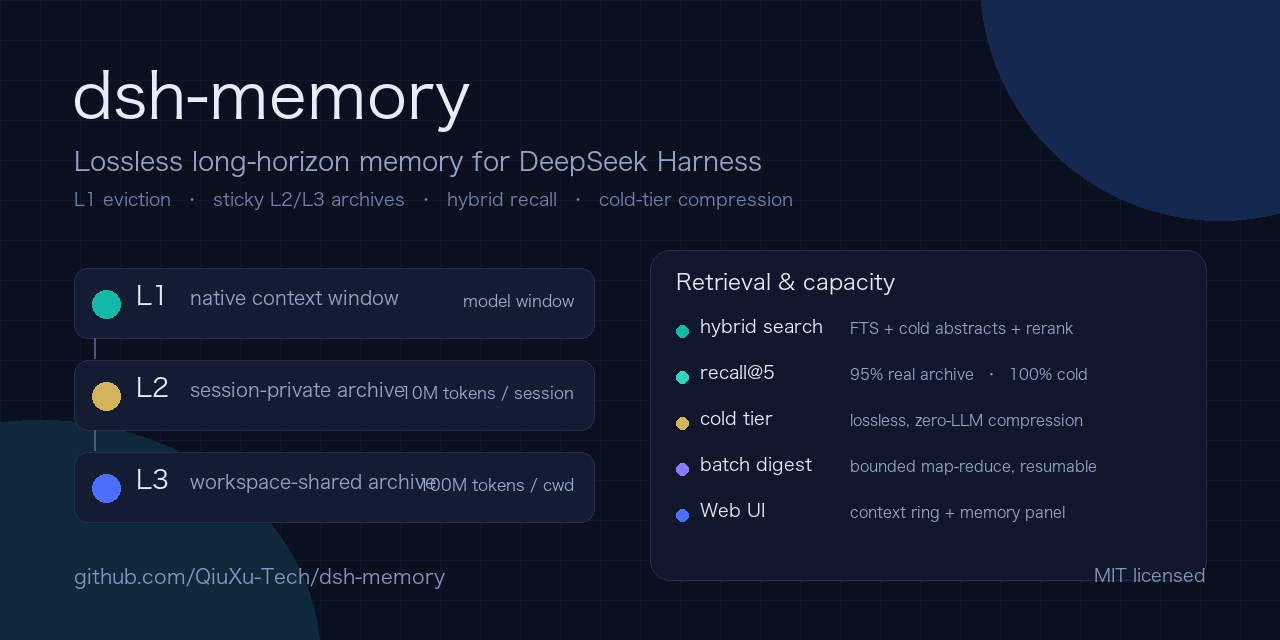
The extra-context layer for AI agents — L1 eviction, sticky L2/L3 context pools, context paging, cold-tier compression.
Expanded retrospective pilot: registration
Registered before the expanded trial and reviews. The frozen, private assignment manifest has SHA-256 fc4bcf1c07c917d752c90547ae4dad2dd41aab19e5a67995f2eafbbf4784fa06; runner and scoring code are pinned to commit a960d10d563e6dedf4eaaca9fd89a5413296dfae. Private source text and the assignment key are not published.
Nine historical user questions from three session snapshots are planned, five conditions each, for 45 answer runs. Four questions appeared in the previous pilot, three more in an earlier replay, and two were not previously scored. These are correlated convenience samples from the same user, not independent production projects, a held-out dataset, or completed real-world tasks. Each trial sees only material preceding its historical question, with up to 40 earlier messages and four recent messages; source clips and available compaction summaries have fixed limits. Elapsed session duration includes inactive time.
The five arms are recent summary, keyword archive, pager only, pager plus read-only tools, and pager plus read/write tools. Arm order is randomized within each task with seed 20261031; task execution order uses seed 20261032, with at most two tasks concurrently. Each answer has at most five tool rounds; on exhaustion, outstanding calls are explicitly denied and one tool-free final response is requested. Exact repeated reads are cached until a write attempt; identical writes are not retried in the same phase. The write arm separately receives chronological earlier messages, without the future question, in bounded intake rounds. No failed model calls or ambiguous writes are automatically retried.
Answer model: claude-haiku-4-5 through the existing APIMaster configuration, temperature 0, maximum 2,500 output tokens. AI answer reviewers: gpt-6-astra and deepseek-flash, with DeepSeek thinking disabled and at most 2,500 output tokens. Answers are assigned randomized anonymous IDs; explicit 0/1/2 anchors and UNKNOWN assess correctness, coverage and evidential support. The source text or answer itself may still reveal the condition. A separate, planned, unblinded AI audit assesses the write-enabled lifecycle. These are AI judgments, not human annotations.
Record all returned usage, cached-token coverage, failures, elapsed time and request/response bytes, including the additional tool-free final calls and six pre-registration diagnostic calls. Actual charges, rates, upstream ingestion and other unavailable costs remain UNKNOWN; no cost savings or production success will be inferred from token counts alone. The study is exploratory, with no significance claim or default-policy decision from this sample.