Memex
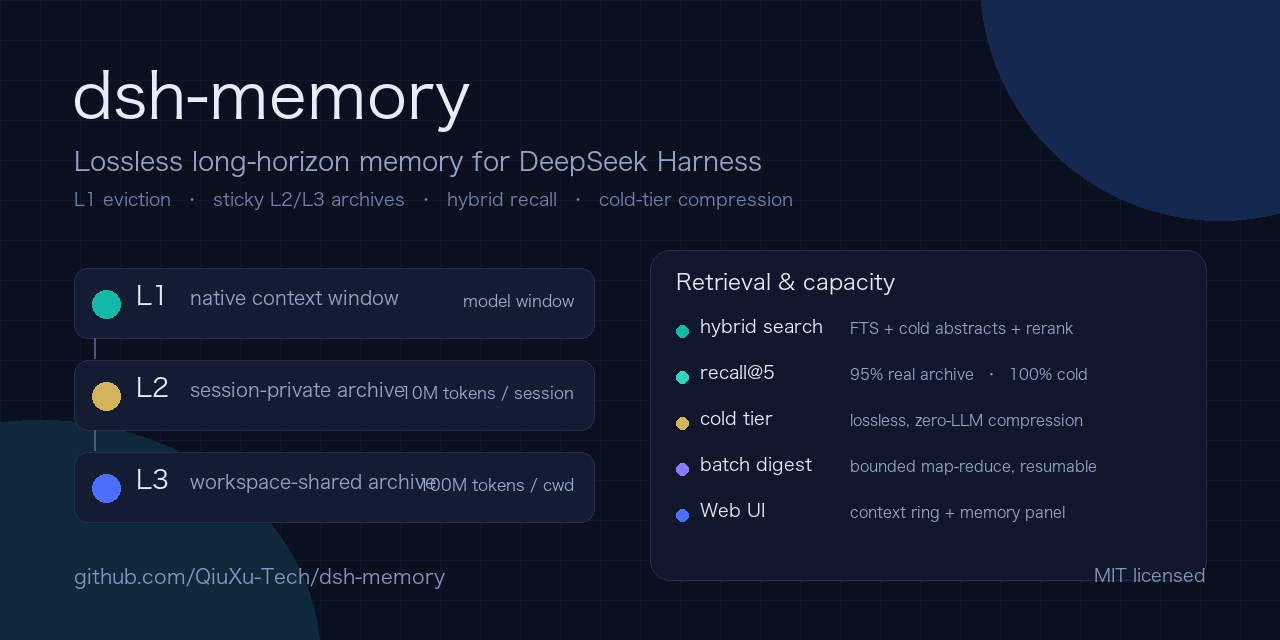
The extra-context layer for AI agents — L1 eviction, sticky L2/L3 context pools, context paging, cold-tier compression.
Optimization findings (v0.2.1 experiments)
Experiments run on the open-source repo at commit 4e9720d (v0.2.1), offline harness + ad-hoc integration benches. Environment note: the machine was under very heavy load during these runs (load average ≈ 72, raw file+fsync ≈ 8.4 ms/op), so wall-clock latencies below are not representative — use the miss rates, relative costs and structural findings. Quiet-machine numbers remain in evaluation.
P0 — hot-body facts are effectively unretrievable (fixed in 0.3.0)
Fix: every record now indexes its identifier-like body tokens into a
record_terms(record_id, term_hash) table (~1.5 rows/record on the test
fixture). When a query term never matched any card candidate and the query has
an identifier-like anchor (digits, hyphens, underscores, paths), the store runs
one indexed GROUP BY to rank body candidates by exact query-term count, reads
only those candidates, and adds bodyHits × 5 to the rerank score. Measured on
the same fixture: hot-body hit@1/hit@5 0% → 100%/100% (40/40 probes),
identifier prefix confusion (INC-1 vs INC-161) removed by boundary-aware
matching, and the DB grows only ~0.6 MB for the 10k-record synthetic pool.
Natural-language-only facts with no identifier anchor still rely on card
summaries / memory_grep; PreCompact now writes a searchable summary head for
this reason.
Original measurement (for the record):
Fixture: 200 distractor records whose title/summary match the topic words (deployment retry budget incident INC-n), 200 answer records whose card is generic and whose answer token lives only in the hot body, 100 cold answer records whose first ~1 KB is indexed as the cold abstract. 30 probes each.
| Probe class | hit@1 | hit@5 | p50 (loaded) |
|---|---|---|---|
| Answer only in hot body | 0% | 0% | 31 ms |
| Answer in cold abstract | 0% | 36.7% | 20 ms |
| Control (title distractor) | 0% | 100% | 19 ms |
Card legs fill the candidate limit, so the hot-body fallback never runs; and even when it does run, body matches only get the fallback base score. Per-model rerank weights do not change this: running the same cold probes under all 7 profile rerank variants (generic/claude/openai/gemini/deepseek/qwen/llama) produced identical hit@1 0% / hit@5 77.5% on that harder cold corpus. The bottleneck is evidence representation, not weight tuning.
Implemented (0.3.0): body-term index rescue with identifier anchors, a body: 5 rerank weight, and a searchable summary head for Claude Code PreCompact archives. Acceptance met on the fixture; see the top of this section.
P0 — PreCompact failed on transcripts > 8 MB (fixed in 0.2.2)
An 8 MB+ transcript was clipped to exactly the store limit then a marker was appended, so normalize() rejected the record (record body is too large); the hook emitted no receipt and archived nothing (observed outBytes: 0). Fixed by clipping to MEMORY_TEXT_LIMITS.body − marker.length; new harness U11 archives a > limit transcript and asserts the marker and size bound.
P1 — transcript archives were unsearchable (fixed in 0.2.2)
Claude Code PreCompact stored a generic summary (“Verbatim Claude Code transcript…”), so a later query about the transcript content could not hit the card fields (body-only gap, P0). The hook now writes the first 900 chars of the transcript (whitespace-normalized) as summary; U6 asserts a content phrase is retrievable.
P1 — injection budgets overflowed by wrapper tokens (fixed in 0.2.2)
clipForForm() clipped the text to the profile budget, then the formatter added XML/Markdown wrapper tokens: measured e.g. Claude catalog 1410 > 1400, DeepSeek 906 > 900. Now the wrapper overhead is reserved (16/12/8 tokens by style): all profiles report ≤ budget (e.g. 1394/1400). Harness U12 checks every profile with an oversized catalog/recall and the MCP version follows package.json.
P1 — Codex adapter gaps (fixed in 0.2.2)
initcrashed withENOENTwhen the--projectdirectory did not exist; it now creates it.- Config path ignored
CODEX_HOME; nowCODEX_HOMEoverrides~/.codex. - Verified:
config.tomlsnippet parses with Pythontomllib, including paths with spaces;--write-configcreates a.bakand is idempotent (second run reports the block already exists).
P1 — MCP/adapters parity gaps (fixed in 0.3.0)
Tools: only 7— MCP now also exposesmemory_list,memory_forgetandmemory_set_status(10 tools total).- L2 session mismatch (verified, documented): hooks write with the client session id while MCP tools use
default-session; the Claudeinitnow warns on L2-only setups and recommends--levels l2,l3/l3or--session. L3 remains the shared path. - Compression: MCP/Codex support cold only; digest summaries remain a DSH-tool/agent responsibility.
- Codex has no hooks: no automatic transcript capture (manual
memory_writeonly).
P2 — model profile coverage & validation (partly fixed in 0.3.0)
- Added profiles for xAI Grok, Cohere Command, Google Gemma, Microsoft Phi (9 → 13 families);
nova-proand other unmapped ids still fall back togeneric. - Real Claude Code acceptance:
claude mcp listin a generated project recognizes the memex server, but project-scoped.mcp.jsonrequires a one-time interactive approval (“Pending approval — run claude to approve”). Codex client acceptance awaits community reports (the generated config is validated by TOML/parse tests). - Windows/token ratios are conservative estimates, not vendor tokenizers.
- Rerank weights: currently no evidence they improve ranking on real data (see P0); consider validating on a real archive or reducing to 2–3 validated profiles.
P2 — retrieval performance (open; needs a quiet-machine rerun)
Re-ran on the same loaded machine (load avg ~14–32; still not a quiet baseline): 10k/100M-token pool wrote in 60.5 s vs the published 2.8 s quiet-machine number, search 101–165 ms, catalog 118 ms, compressCold 23.8 s, cold GC 2.57 s. Relative bottlenecks identified earlier (loaded): long ASCII queries pay the LIKE leg (~52 ms at 2k; 375 ms via MCP at 11k), body fallback ~82 ms p50 at 2k, memory_index aggregates facets + 3 lists. Candidate optimizations:
- LIKE leg: only for terms
<3chars (CJK bigrams) or cap to 4 terms × title/summary/abstract; measure recall delta. - Body fallback: early exit once enough matches are found; cap candidates (currently scans 400 hot records and reads bodies).
- Facets: cache hot/cold accounting or combine COUNT queries; catalog currently recomputes facets per call.
- Re-run
scripts/scale-bench.mjson a quiet machine to confirm the published 10k numbers (search 16.7–28.8 ms, write 2.8 s).
P2 — process startup
Plain-node (no test loader) startup: session-start hook 282–413 ms, MCP initialize 234 ms; the offline loader adds ~150–800 ms (development only). Hooks are short-lived processes fired per event; if this matters, ship a small pre-bundled hook entry (fewer imports) or keep the MCP server warm.
MCP protocol robustness (verified, no action)
Malformed JSON → -32700; unknown method → -32601; unknown tool → isError text; missing args → isError; unknown resource → -32602; duplicate initialize accepted; no crashes observed.
Performance pass (v0.3.1)
Measured on the same seeded 10,000-record store (mixed ASCII/CJK cards, ~1.5 KB bodies) on a quiet pass (load avg ≈3), medians of 7 runs, CPU and wall time agreeing. Before/after:
| Operation | Before | After | Δ |
|---|---|---|---|
facets |
9.82 ms | 5.18 ms | −47% |
catalog |
16.32 ms | 11.87 ms | −27% |
| search: long ASCII | 20.65 ms | 10.70 ms | −48% |
| search: short ASCII | 13.33 ms | 5.69 ms | −57% |
| search: generic NL | 20.92 ms | 10.45 ms | −50% |
| search: rescue (id anchor) | 23.87 ms | 12.92 ms | −46% |
| search: body fallback | 14.92 ms | 13.42 ms | −10% |
| search: CJK 2/3-char | 4.58 / 11.96 ms | 4.63 / 11.99 ms | ~0 |
Changes:
- Adaptive LIKE leg — trigram FTS already matches substrings for terms ≥3 chars, so the 4-field leading-wildcard LIKE OR-scan only runs when the FTS leg is sparse; CJK terms always keep LIKE (no word boundaries in Chinese).
- One-pass facets — the 7 separate aggregate scans were replaced by a single
GROUP BY kind,status,scope,coldpass folded in JS. - Single-read body fallback — reads each candidate file once and reuses a precompiled regex instead of calling
grep()per row; candidate cap 400 → 200. - Body-term rescue is now anchored to identifier terms only (v0.3.0) — no full body scans.
Recall guard (same 40-question real-archive suite): hit@5 95% → 95%, cold recall 100% → 100%, hit@1 73% → 70% (a rescue-hit tie-break trade-off; synthetic/demo suites stay 100%). Raw numbers: docs/assets/benchmarks/perf-optimization.json.
Remaining perf work: LIKE/facets are now cheap relative to FTS bm25 ranking; the next candidates are caching facets per store epoch and a quiet-machine 100M-pool rerun.
Suggested backlog
| Priority | Item | Acceptance |
|---|---|---|
| P0 | hot-body hit@1/@5 0% → 100% on fixture; U13 | |
| P0 | PreCompact/budget/Codex fixes (0.2.2) | harness 110/110 |
| P1 | MCP parity tools + session handling (0.3.0) | 10 tools; L2 warning; U14 |
| P1 | Real-client acceptance | Claude Code recognizes the MCP server (approval pending); Codex usage reports welcome |
| P2 | Retrieval perf pass (LIKE/fallback/facets) — done in 0.3.1: facets −47%, long search −48%, real hit@5 95% preserved | 100M-pool quiet rerun still open |
| P2 | Profile coverage/validation | 13 families covered; rerank weights still unvalidated on real data |