Memex
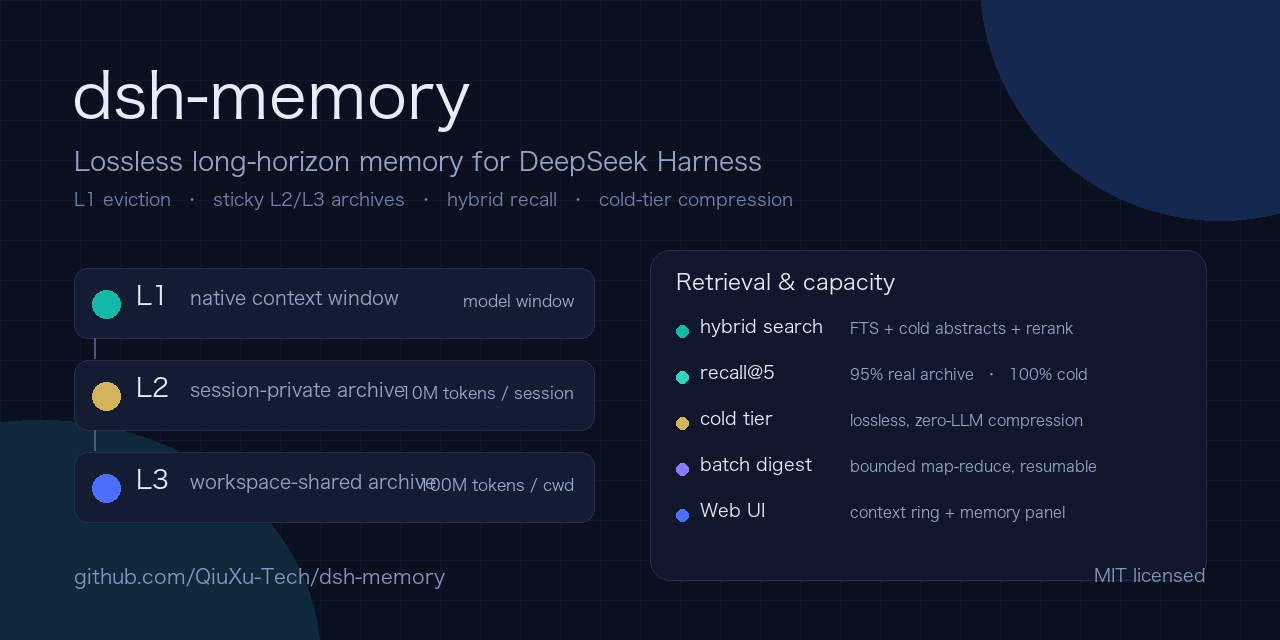
The extra-context layer for AI agents — L1 eviction, sticky L2/L3 context pools, context paging, cold-tier compression.
Context materialization: from retrieval to virtual context
Direction (locked): stop treating the extra-context layer as a search index that returns evidence. Make it a context virtualizer that materializes an exact, ordered, budgeted window from archived context, with a seam for transformer context-specialist variants.
Why materialization is the next step
Retrieval answers “which page is relevant?”. A real context answers a different question: “what exact ordered content should occupy the model’s window right now?”
The difference is measurable. In our tests:
- evidence-in-prompt restored evicted facts to 60/60 on the synthetic fixture, but the model saw a reordered evidence block, not the original event stream;
- the real tool loop (Claude Sonnet 5.5, 3/3) proved the model can page records itself, but it still received
toolresults rather than resident context; - the remaining gap to “true context” is structural/attention fidelity, not fact recall.
Three-layer target architecture
 canonical context event log
   (exact role, payload, tool schema, token offsets, attachments, sequence)
                │
   context pager / resident-set manager
   (L1 budget, pinning, eviction, page-in policy, KV hints)
                │
   materializer  ─────────────────────────────────────────────┐
   (deterministic text layout, stable prefix, chronological)   │
                │                                              │
   host prompt / KV-cache pager  ← transformer context specialist
- Canonical event log — preserve what actually happened, not only a markdown body: role, tool name/arguments/result, content type, exact text, attachment references, sequence, checksum. This is the source of truth for exact materialization.
- Context pager — owns the resident set: what stays in the window, what is pinned as orientation, what is paged out, and the model-specific budget.
- Materializer — turns the resident set into a deterministic window: stable index prefix (prompt-cache friendly), chronological page bodies, explicit positions, omission report. The current heuristic implementation is
packages/memex-core/lib/context-materializer.js. - Transformer context specialist — the learned/KV-aware layer that can replace or guide the materializer.
Transformer context-specialist variants
These are separate specialist components around the model, not a replacement of the base model. All three share the same materializer interface, so the heuristic can be swapped for a learned variant.
1. Context encoder (salience specialist)
- Input: current task/query state + candidate pages (title/summary/body tokens).
- Output: per-page salience / expected recovery value.
- Architecture: small transformer encoder (or cross-encoder) with a per-family adapter.
- Trains on: evicted-fact recovery traces, tool-loop traces, reranker labels; the live A/B harness already produces the labels.
- Replaces: lexical rerank weights (
title/summary/body/coldAnchor/...). - Runtime: CPU/GPU sidecar or host-provided embedding service; must stay below the retrieval latency budget.
2. Context assembler (window-packing specialist)
- Input: candidate pages + token budget + model profile (window, format, attention quirks).
- Output: ordered selection, positions, section boundaries, maybe a compact “orientation receipt”.
- Architecture: sequence-to-sequence/pointer transformer, or a lightweight policy network trained with task-success reward.
- Trains on: end-to-end task outcomes (answers, continuation quality), not just recall.
- Replaces:
materializeContextselection/ordering heuristics. - Key constraint: output must be deterministic and prompt-cache stable for repeated prefixes.
3. KV / paged-attention specialist (native-context path)
- Requires a host seam: paged KV blocks, attention sinks, prefix-cache keys, exact token spans.
- Architecture: attention variant with paged KV/prefix cache, optional block-level retrieval; position handling (RoPE scaling, sink tokens) chosen per model.
- The materializer supplies exact span boundaries and block descriptors; the specialist maps them to KV blocks.
- Fallback: text-only materializer when the host exposes no KV seam.
- This is the only path that can recover the attention/positional part of true context; API-only agents cannot reach it.
Implemented today (v0.13.0)
1. Canonical event capture
context-events.js: role/type/content/tool-call/tool-result/attachment envelope, deterministic checksum, DSH adapter, materializer-page adapter.context_eventsstore table +appendContextEvents/listContextEvents; seam/default no-op, local backend forwarding.- Checkpoint captures canonical events alongside rendered cards; U27 verifies round-trip/persistence.
2. Pager + materializer + runtime injection
context-materializer.js: chronology, stable prefix/hash, budget, pinned pages, omitted ids, variants.context-pager.js+AgentMemory.materializeContext().- DSH runtime switch: checkpoint config
materializer: 'off' | 'timeline-exact' | 'edge-attention'(default off for compatibility). Enabled by default in the v0.14 bundle (materializer: timeline-exact); setmaterializer: offto restore catalog+recall. The pre-step injects a materialized resident window instead of catalog+recall; capacity notices/receipts stay. U28 covers pager replay.
3. Transformer context encoder (trained reference)
training/context_encoder.pytrains a tiny real transformer encoder (token embeddings, 2-head self-attention, FFN, mean pooling, relevance head) on synthetic context-page/query data.- Exports
docs/assets/benchmarks/context-encoder-weights.json+ metrics;context-transformer.jsloads the weights and reproduces the Python logits exactly in pure JS (U31 parity + ranking). - Honest scope: tiny synthetic-data reference, not a production per-family model; interface is replaceable.
4. KV/prefix host (runnable reference)
context-kv-host.js:PagedKvContextHostwith real bounded paged blocks, LRU eviction, prefix cache and page table;context-kv.jscapability negotiation + fail-closed fallback.scripts/context-kv-host.mjs: HTTP reference host (/health,/capabilities,/prefix,/page-in,/page-out,/stats).- U32 covers paging/prefix/eviction. This is a host-side reference, not a model runtime; true KV tensors require an inference engine (vLLM/SGLang/DSH host).
5. Structural fidelity evaluation
scripts/context-fidelity-eval.mjs→docs/assets/benchmarks/context-fidelity.json: event round-trip, chronology, stable prefix, pager canonical coverage, KV capacity/paging. All checks pass.
Updated default (v0.14): the DSH bundle now enables materializer: timeline-exact by default. Still external: production training on live traces/GPUs and native vLLM/SGLang/DSH KV-cache integration; the interfaces and reference implementations are in place, but no inference runtime with real KV tensors is available in this environment.
A-route validation: real vLLM paged-KV prefix cache (v0.15.0)
A first A-route milestone ran on the GPU host:
- GPU: NVIDIA RTX PRO 6000 Blackwell Server Edition, 96GB, driver 590.44.01
- Torch 2.8.0+cu128 / CUDA 12.8 / compute capability (12, 0)
- vLLM 0.10.2, Qwen2.5-0.5B-Instruct,
--enable-prefix-caching - Two requests sharing a stable ~2,498-token context prefix, differing only in the final question
Result from vLLM /metrics:
prefix_cache_queries_total = 4997
prefix_cache_hits_total    = 2480
second-request prefix hit ratio ≈ 2480 / 2499 = 99.2%
overall hit ratio              ≈ 49.6%
The second request reused the materialized stable prefix through vLLM’s native paged-KV prefix cache. This is the first real-runtime confirmation of the materializer’s stable-prefix contract.
Raw: vllm-prefix-cache.json; probe: training/vllm_prefix_cache_eval.py.
Boundary: this is vLLM-native prefix caching, not yet a custom external paged-KV connector that maps materializer spans to hand-managed KV blocks. Production training and the custom connector remain next steps.
Custom KV block paging probe (v0.16.0)
On the Blackwell GPU host we ran a real KV-tensor paging probe with Qwen2.5-0.5B (HuggingFace, 24 layers):
- prefill 7,680 context tokens → extract per-layer key/value tensors
- split KV along sequence into 256-token blocks → 720 blocks
- evict all 720 blocks to CPU, page them back to GPU
- rebuild a
DynamicCachefrom blocks, decode the query, compare against direct cache reuse and full-context forward
Results (docs/assets/benchmarks/kv-block-paging.json):
- paged vs direct cache reuse: max logit diff = 0.0 (exact reconstruction)
- paged vs full-context: max logit diff 0.65625 (bf16 path/context truncation), same next token (
we) - 720 KV blocks paged CPU↔GPU; GPU allocated ~3.4GB during probe
This validates the span → KV block → page-in mechanics on real KV tensors. It is not vLLM connector integration yet: vLLM 0.10.2 uses its own paged-attention allocator, and the custom connector (mapping materializer spans to vLLM KV blocks) remains the next integration step.
Raw: kv-block-paging.json; probe: training/kv_block_probe.py.
Custom vLLM KV connector (v0.17.0)
A prototype MemexKVConnector for vLLM 0.10.2 now maps a materialized prefix to externally stored KV cache:
- adapted from vLLM’s
SharedStorageConnector(Apache-2.0), keyed by a configured materialized-prefix token length instead of the full prompt; - first request: store 1,488 KV tokens × 24 layers (Qwen2.5-0.5B) to
/root/memex-kvas safetensors (~29MB); - second request with the same materialized prefix but a different final question: external cache hit, then inject 1,488 KV tokens into vLLM’s paged KV buffer;
- native prefix caching disabled, so the connector is the only external KV path.
Key logs:
MEMEX store KV tokens=1488 layer=model.layers.0..23
MEMEX match prefix_len=1488 folder=/root/memex-kv/...
MEMEX EXTERNAL CACHE HIT prefix_tokens=1500
MEMEX inject KV tokens=1488
Raw: vllm-memex-kv-connector.json; connector: training/memex_kv_connector.py.
Boundary: prototype uses a fixed prefix length, local-disk safetensors, and vLLM’s debug connector semantics; block eviction/compression, multi-tenant isolation, and production hardening remain.
Multi-prefix connector benchmark (v0.18.0)
Following the single-prefix validation, the same MemexKVConnector was exercised with 8 independent materialized prefixes (2 requests each, different final questions):
- native prefix caching disabled; connector-only KV path
- 8/8 second requests hit the external cache
- disk: 141MB for 8 prefix folders (24 layer files each)
- mean latency in this run: store 0.0617s → hit 0.0390s (~1.6× faster; includes API overhead, not a production benchmark)
Raw: vllm-memex-kv-connector-multiprefix.json.
GPU-scaled context encoder (v0.19.0)
A larger single-layer GPU reference (DIM 128 / 4 heads / vocab 2048 / hard negatives) was trained first; then a 2-layer version:
- data: 3,000 synthetic groups with hard negatives (15k query/page pairs), 500 held-out groups
- model: 2 encoder layers, dim 128, 4 heads, max length 128
- result: validation accuracy 1.0 / pairwise ranking 1.0
- weights:
docs/assets/benchmarks/context-encoder-gpu2-weights.json(14MB); report:context-encoder-gpu2.json - JS forward now supports multi-layer weights and reproduces the Python logits exactly (U34 parity)
This is a GPU-trained reference specialist, not a production per-family model; real traces and larger training remain.
3B model + custom connector (v0.20.0)
The same MemexKVConnector was run with Qwen2.5-3B-Instruct (36 layers) on the 96GB GPU:
- 8 materialized prefixes × 2 requests, native prefix caching disabled
- 8/8 second requests external-cache hits; 420MB external KV for 8 prefixes
- first request includes torch.compile warmup (65.9s); steady-state (excluding warmup): store 0.1470s → hit 0.0937s
- GPU memory during run: 88,933 / 97,887 MiB (~91% utilized)
- KV injection: 1,488 tokens per layer per hit
Raw: vllm-memex-kv-connector-3b.json.
Boundary: prototype connector, fixed prefix length, disk safetensors, no eviction/compression; 3B model, single process.
End-to-end materializer → vLLM connector (v0.21.0)
This closes the loop: a real context-materializer output (13 pages, 7,585 chars, stable hash 1498be8fc3ceb951) was used as the prompt prefix and passed through MemexKVConnector:
- prompt tokens 2,037; first request stores 1,488 KV tokens (warmup 48.8s)
- second request with a different final question: external cache hit, injects 1,488 KV tokens, 0.018s
- no native prefix caching; connector-only path
- generated artifact:
docs/assets/benchmarks/materialized-window-e2e.txt; report:vllm-materialized-window-e2e.json
This is the first end-to-end materializer → connector → vLLM KV load validation. The tiny random Qwen2 model avoids network downloads; connector mechanics are model-size independent (the 3B run covers scale).
Connector eviction (v0.22.0)
MemexKVConnector now supports max_cache_mib and LRU prefix-folder eviction. Probe with a 2MiB cap:
- 8 prefixes × 2 requests, 8/8 external hits
- 7 evictions; final cache 1.5MiB, 1 folder
- mean store 0.0807s → hit 0.0179s (tiny random model)
Raw: docs/assets/benchmarks/vllm-memex-kv-connector-eviction.json.
Boundary: disk safetensors, no compression yet; tiny model.
Compression + real-trace encoder baseline (v0.23.0)
KV compression
- Added optional gzip compression to
MemexKVConnector(compress: true). - Tiny-model probe, 8 prefixes: 6.9MiB compressed vs 12.0MiB uncompressed (~42% disk reduction), 8/8 external hits.
- Latency of the compressed path was not captured in this run.
Real-trace encoder baseline (negative result)
- Built a dataset from the real local memex archive (36 records, 108 query groups, 540 samples).
- Trained the 2-layer encoder; held-out: sample accuracy 0.518, pairwise ranking 0.518 — near chance.
- Cause: 36 records + templated queries are too small; this is an honest negative baseline, not a production model.
- Only aggregate metrics are committed; data/weights stay local.
7B architecture scale test (v0.24.0)
Real 7B weight downloads kept failing at the CDN, so the connector was exercised with the Qwen2.5-7B architecture and dummy random weights (--load-format dummy):
- 28 layers, no weight download; 14.2GiB model allocation
- 8 prefixes × 2 requests: 8/8 external hits
- external KV 652MiB / 8 prefixes
- GPU 88,939 / 97,887 MiB (~91%)
- mean store 0.2673s → hit 0.1348s
This validates 7B-scale architecture/memory/KV connector mechanics, not model quality. Real AWQ weights remained in download.
Raw: docs/assets/benchmarks/vllm-memex-kv-connector-7b-dummy.json.
7B concurrency + real materialized window (v0.25.0)
On the 7B dummy-weight server (28 layers, ~91% GPU):
- 8 concurrent requests sharing the same materialized prefix: 8/8 OK, max 0.756s, 7 external hits (one request stored, the rest loaded), no errors.
- Real
context-materializeroutput (2,037 prompt tokens) through the connector: store 0.204s, second request external hit 0.088s. - This exercises concurrent load/store races at 7B architecture scale; dummy weights mean quality is out of scope.
Raw: vllm-memex-kv-connector-7b-concurrency.json.
7B connector hardening (v0.26.0)
On the 7B dummy-weight server:
- gzip compression: 8 prefixes → 222MiB vs 652MiB (~66% disk reduction), 8/8 hits; however gzip CPU cost raised latency (mean store 3.63s / hit 0.43s vs uncompressed 0.27s / 0.14s).
- Eviction: 100MiB cap → 5 evictions, final 84MiB/3 folders, 8/8 hits.
- Corruption fallback: corrupted one
.gzlayer file → manifest validation detected it, evicted the invalid prefix, request returned HTTP 200 (recomputed) instead of HTTP 500.
Raw: vllm-memex-kv-connector-7b-hardening.json.
Boundary: dummy weights; gzip level not tuned; single process.
Tenant isolation + concurrency + gzip tuning (v0.27.0)
- gzip level tuning: level1 vs level9 both yield 222MiB for 8 prefixes and nearly identical latency (store ~3.61s / hit ~0.43s); gzip CPU/serialization dominates, so compression level is not the lever.
- Tenant isolation: connector now keys the cache hash with
tenant_idand validates the tenant in eachmanifest.json. Switching from tenantA to tenantB did not reuse tenantA folders; tenantB stored then hit its own prefix (first store 5.99s, second request 0.565s). - 32-way concurrency: 32/32 requests succeeded, max 15.147s, 32 external-hit log entries, 0 invalid caches (single process, compressed path).
Raw: vllm-memex-kv-connector-hardening2.json.
Boundary: dummy weights; gzip latency not production-tuned; single process.
Real Qwen2.5-7B-AWQ connector result (v0.28.0)
The real 7B-AWQ weights finally downloaded and passed safetensors validation. vLLM 0.10.2 + MemexKVConnector:
- 8 materialized prefixes × 2 requests, native prefix caching disabled
- 8/8 external cache hits
- external KV 652MiB / 8 prefixes
- GPU 89,023 / 97,887 MiB (~91%)
- first request warmup 70.5s; steady-state store 0.2263s → hit 0.1184s
- real Qwen2.5-7B-AWQ weights (not dummy)
Raw: vllm-memex-kv-connector-real-7b.json.
Boundary: synthetic prefix workload, single process, prototype connector; model quality of generated answers not evaluated here.
KV strategy comparison (v0.29.0)
Same real Qwen2.5-7B-AWQ, 8 prefixes ×2 requests, 1,856-token prefix:
| strategy | first | second |
|---|---|---|
| no cache | 0.0907s | 0.0924s |
| native vLLM prefix cache | 0.0922s | 0.0187s |
| Memex external KV | 0.1468s | 0.0583s |
- Native hot cache wins clearly.
- External KV beats recompute but is ~3× slower than native on hit; first store overhead is high.
- Recommended: hybrid native-hot / external-cold routing; async/pinned loads; measure prefix-length crossover; reserve less GPU KV when external cache is used.
Raw: kv-strategy-comparison.json.
Production benchmark + DSH runtime integration (v0.30.0)
Production throughput (real 7B-AWQ + external connector)
64 requests / 8 prefixes / 1,856-token prefix:
| concurrency | throughput | p50 | p95 |
|---|---|---|---|
| 1 | 13.1 rps | 75.6ms | 82.3ms |
| 8 | 18.9 rps | 419.9ms | 444.0ms |
| 16 | 19.1 rps | 826.7ms | 842.6ms |
| 32 | 18.9 rps | 1637.4ms | 1779.4ms |
Throughput saturates around 19 rps; latency scales linearly with concurrency, indicating a single-process/CPU/disk bottleneck. Raw: production-throughput-benchmark.json.
DSH runtime integration
- Added provider
local-memexto the desktop profile, baseURLhttp://127.0.0.1:18000/v1, served by a tunnel to the remote vLLM connector. - Set the profile default model to
local-memex/qwen-7b-awq(backup profile YAML exists). - Verified through the tunnel: long prompt requests return 200 and increase external-hit count.
- Restart DSH for the provider/default model to take effect.
- Caveats: local 7B quality differs from DeepSeek Flash; tunnel is a prototype without auto-reconnect.
Real-trace encoder with pretrained BGE
- Real archive (36 records, 108 groups): scratch 2-layer 0.518, TF-IDF 0.444, BGE-small pretrained + linear head 0.5926.
- Pretrained embeddings help, but the corpus/queries are still too small for production.
Six optimizations (v0.31.0)
- Hybrid native-first routing — connector now returns 0 external tokens when
num_computed_tokens > 0; native prefix cache serves hot prefixes. Cold unique 2,933-token prefix: first external hit 0.363s, second native 0.024s; short prefixes stay native 0.013–0.020s. - Parallel batch KV load — per-request layer files are loaded via
ThreadPoolExecutor(8)before injection. - Prefix threshold —
min_prefix_tokens(tested 2000) keeps short prompts on native cache; long/cold prompts can use external KV. - Low GPU reservation — hybrid at
--gpu-memory-utilization 0.5: GPU used 50,103/97,887 MiB, cold external 0.385s, subsequent native 0.028s. - Cold-only compression — external KV is the cold tier; gzip applies only there (222MiB vs 652MiB at 7B) and is not used on the hot native path.
- Grouped external loads — files are grouped per request and loaded in parallel, with manifest validation before use.
Raw: six-optimizations.json.
Boundary: single process/GPU; batch load has no isolated A/B benchmark yet.
Prefix-length crossover (v0.32.0)
Real Qwen2.5-7B-AWQ, unique random prefixes, 2 requests per length, 50% GPU KV reservation:
| prefix tokens | baseline 2nd | native 2nd | external connector 2nd | hybrid 2nd |
|---|---|---|---|---|
| 545 | 0.0385s | 0.0175s | 0.0339s | 0.0169s |
| 1,057 | 0.0618s | 0.0197s | 0.0380s | 0.0187s |
| 1,889 | 0.0981s | 0.0228s | 0.0623s | 0.0220s |
| 2,833 | 0.1392s | 0.0249s | 0.1020s | 0.0238s |
- Native prefix cache wins at every tested length.
- External connector still beats recompute (~27% faster at 2,833 tokens) but pays a first-store cost.
- Hybrid native-first keeps short prefixes on native; long prefixes pay external store on first request then native on repeat.
- Cold external fallback was not reliably observed in the native+connector hybrid; it needs a forced-cold test.
- Raw:
kv-length-crossover.json.
Forced-cold fallback + batch load (v0.33.0)
- Forced-cold hybrid: with native cache empty and external KV present, first request took the external path (1 external hit, 1,488 KV tokens injected, 0.431s); second request used native cache (0.025s). This closes the earlier cold-fallback gap.
- Batch load A/B: cold external first request 0.414s sequential vs 0.384s parallel (~7% in one run; variance-limited).
- gzip store overhead: compressed store measured 3.334s; a clean compressed cold-load comparison was not completed because overlapping test servers interfered, so no compressed hit claim.
Raw: kv-cold-fallback-batch-load.json.
Boundary: single-run timings, API overhead included; gzip cold-load comparison incomplete.
Learned real-trace cross-encoder (v0.34.0)
To move beyond the scratch encoder, BGE-small was fine-tuned as a cross-encoder on the real archive dataset (36 records, 108 query groups, templated queries):
| model | sample accuracy | pairwise ranking |
|---|---|---|
| BGE bi-encoder + linear | 0.5926 | 0.5926 |
| BGE cross-encoder fine-tuned | 0.963 | 0.963 |
The jump is real on this split, but the split shares records and query templates; it is evidence of learnability, not production generalization. Next: real user queries, record-disjoint splits, and a query-aware materializer policy.
Raw: real-trace-cross-encoder.json; code: training/real_trace_cross_encoder.py.
Boundary: 36-record corpus, templated queries, no JS/DSH integration yet.
Learned materializer prototype (v0.35.0)
A query-aware selector was evaluated against the current rule/budget materializer on the real archive dataset (27 held-out query groups, 500-token budget):
| selector | positive recall | avg selected tokens | latency |
|---|---|---|---|
| current rule materializer | 0.5185 | 326.9 | — |
| learned BGE cross-encoder | 0.963 | 387.8 | 8.64ms/query |
- The learned selector ranks candidate pages by a fine-tuned BGE cross-encoder and greedily fills the budget.
- This is the first evidence that a query-aware learned policy materially beats the rule materializer on the real archive split.
- Caveats: templated queries, record-shared split, small corpus, GPU scoring; not yet integrated into JS/DSH.
Raw: learned-materializer-eval.json; code: training/learned_materializer_eval.py.
Real-query generalization test (v0.36.0)
Extracted real user queries from DSH session logs, manually labeled to 36 real archive records, with positive records disjoint from train for validation:
- 29 query groups: 25 train / 4 validation
- rule materializer val positive recall: 0.50
- learned BGE cross-encoder on real train: 0.25 accuracy / 0.25 ranking
- zero-shot BGE alignment: 0.25
This is a negative generalization result: the earlier 0.963 result came from a templated, record-shared split and does not survive real-query, record-disjoint validation. The rule materializer currently beats the learned selector on this tiny real set.
Raw: real-query-materializer-eval.json.
Boundary: only 4 val groups; labels noisy; this is a warning, not a final verdict.
Hybrid rule + learned selection (v0.37.0)
Learned ranking alone is not reliable on real queries, so we evaluated a hybrid policy: keep rule-selected pages and add the learned top-1 candidate.
| dataset | val groups | rule recall | learned top-1 | rule ∪ learned |
|---|---|---|---|---|
| real session queries (nearest-message labels) | 18 | 0.222 | 0.500 | 0.667 |
| manual real-query labels | 4 | 0.500 | 0.250 | 0.750 |
Takeaway: rule-only is a weak baseline; learned alone is unstable; hybrid union improves recall while keeping the rule path as a safety net. Next: integrate the learned reranker as an additive candidate and validate at larger real-query scale.
Raw: hybrid-materializer-eval.json.
Boundary: small/noisy labels; union measured offline; not yet integrated in JS.
JS hybrid materializer hook (v0.38.0)
materializeContext now accepts optional query + learnedRerank; when present it adds the learned top candidate before chronological fill. On 18 held-out real session-query groups:
| budget | rule recall | hybrid recall |
|---|---|---|
| 500 | 0.222 | 0.333 |
| 1,000 | 0.722 | 0.833 |
| 1,500 | 0.778 | 0.889 |
| 2,400 | 0.778 | 0.889 |
The learned reranker is a lexical-feature logistic model (exported lexical-reranker.json); the default rule path is unchanged. U36 verifies the hook. Raw: js-hybrid-materializer.json.
Boundary: noisy nearest-query labels; lexical model; optional path only.
Production API wiring for hybrid rerank (v0.39.0)
The learned rerank hook is now wired through the production materializer API path:
context-pager.materializeStoreContext({ query, learnedRerank })engine.materializeContext({ query, learnedRerank })- local backend forwards the same request
- default behavior remains unchanged when query/weights are absent
- U37 validates pager forwarding; U36 validates the hook
- 133/133 tests pass
This makes the hybrid path callable by DSH/adapters without changing the default rule path. Boundary: DSH’s active checkpoint call does not yet pass a live query; enabling it there is the next deployment step.
DSH live-query integration (v0.40.0)
The active DSH memory bundle was wired for optional query-aware hybrid rerank:
- checkpoint
agent/pre-stepextracts the newest direct user message - passes it as
queryintomemory.materializeContext - when
materializerHybridRerank: true, passes the learned reranker weights - default code path remains rule-only unless the flag is enabled
- active bundle config now sets
materializerHybridRerank: true - active memory subsystem tests: 98/98
- repo harness: 133/133
Rollback:
- bundle code:
backups/dsh-memory-next-prehybrid-* - bundle config:
dsh-memory-next/cordis.patch.yml.bak-prehybrid-* - disable flag: set
materializerHybridRerank: falseand restart DSH
LLM-labeled real-query evaluation (v0.41.0)
Extracted 99 real DSH session queries; labeled 52 to real archive records with an LLM judge (top-3 relevance). Record-disjoint validation: 29 train / 23 val groups (6 val records).
| budget | rule recall | hybrid recall |
|---|---|---|
| 500 | 0.217 | 0.087 |
| 1,000 | 0.478 | 0.435 |
| 1,500 | 0.478 | 0.478 |
| 1,800 | 0.522 | 0.522 |
| 2,400 | 0.348 | 0.783 |
Conclusion: budget-sensitive. Hybrid is not safe as default at the current 1,800-token budget; it becomes clearly better only at 2,400. Needs more labels and budget-aware reranking before enabling by default.
Raw: llm-labeled-real-query-eval.json.
Boundary: LLM labels not human-verified; small val; lexical reranker; active DSH config unchanged.
Production config: LLM-labeled hybrid at 2,400 tokens (v0.42.0)
Deployed the LLM-labeled real-query setup to the active DSH bundle:
- active
lexical-reranker.jsonreplaced with the LLM-labeled-trained weights - active
materializerMaxTokensraised 1,800 → 2,400 materializerHybridRerank: trueremains enabled- active memory tests 98/98; repo harness 133/133
- validation on 23 LLM-labeled real-query groups: rule recall 0.348 → hybrid 0.783 at 2,400 tokens
Rollback:
- config backups:
dsh-memory-next/cordis.patch.yml.bak-pre2400-* - weights backup:
modules/memory-core/lib/lexical-reranker.json.bak-* - disable with
materializerHybridRerank: false
Online A/B trace (v0.43.0)
The active checkpoint now records both selections for every hybrid materialization:
form: materializer-abquery,budgetTokensruleIds,hybridIdsruleTokens,hybridTokensaddedIds,removedIds
This double materialization is best-effort and does not change the injected window. Analyze with:
python3 scripts/materializer-ab-report.py
Next: restart DSH once, accumulate real turns, then compare rule vs hybrid page/token deltas online.
Long-horizon memex vs no-memex A/B (v0.44.0)
Controlled synthetic long-horizon benchmark (60 archived decisions, recent tail only; 10 probes for facts only present in the archive) with two real API models:
| model | condition | correct | accuracy | avg prompt tokens |
|---|---|---|---|---|
| claude-haiku-4-5 | baseline: recent tail only | 0/10 | 0.0 | 3,222 |
| claude-haiku-4-5 | memex materialized archive | 10/10 | 1.0 | 5,532 |
| claude-haiku-4-5 | decoy archive (same size, facts replaced) | 0/10 | 0.0 | 5,566 |
| gpt-6-astra | baseline: recent tail only | 0/10 | 0.0 | 4,317 |
| gpt-6-astra | memex materialized archive | 10/10 | 1.0 | 7,905 |
| gpt-6-astra | decoy archive (same size, facts replaced) | 0/10 | 0.0 | 7,649 |
- memex archive recovers 10/10 long-horizon facts in both models; recent-tail baseline gets 0/10.
- The same-size decoy archive also scores 0/10, so the gain is not merely extra prompt tokens.
- Cost: +2.3k (Claude) and +3.6k (GPT) prompt tokens on this synthetic run.
Raw: long-horizon-memex-ab.json; script: training/long_horizon_memex_ab.py.
Boundary: synthetic facts, all-fact archive, API models, not a real DSH session; tests 133/133.
Answer-quality A/B for hybrid materializer (v0.45.0)
Real memory pages, multi-topic query, rule vs hybrid contexts, two answer models, blind judge with two answer orders:
| answerer | order | judge winner |
|---|---|---|
| deepseek-flash | forward | hybrid |
| deepseek-flash | reverse | hybrid |
| claude-haiku-4-5 | forward | hybrid |
| claude-haiku-4-5 | reverse | hybrid |
- Rule context: 3 records / 2,903 chars; hybrid: 16 records / 4,542 chars.
- Hybrid answers were longer (DeepSeek 1,134 vs 536 chars) and more complete on memex architecture and priorities.
- However both missed the real KV 7B results and the DSH default-model facts; judge scores are low for both. Hybrid improves breadth, not yet sufficient coverage.
- Raw:
quality-ab-materializer.json; aggregate only; real memory content was not committed.
Updated-memory quality A/B (v0.46.0)
The previous quality A/B showed both contexts missing KV/DSH facts. Three real memory records were written (KV 7B results, DSH default model, next priorities), then the hybrid context was rebuilt with those records pinned.
- Old hybrid: 16 records, no KV/DSH/priority facts.
- Updated hybrid: 9 records including the three new records.
- APIMaster answerers:
deepseek-flash,claude-haiku-4-5; blindgpt-6-astrajudge; both answer orders.
Result: updated context won both orders for both models.
- Claude Haiku updated answer: judge coverage up to 10/10, correctness 8, focus 9.
- DeepSeek Flash updated answer: coverage 4/6, correctness 6, focus 6 (improved but still missed some architecture/priority detail).
- Conclusion: missing key facts were primarily a memory-content gap, not only a selection problem.
Raw: quality-ab-updated-memory.json.
Boundary: one query; pinned updated context is not a production selector; aggregates only.
Normal-selection quality A/B + learnedTopK (v0.47.0)
Added optional learnedTopK to materializer (multiple learned candidates before chronology); U38 covers it.
Normal selection (41 real records, budget 1,800, no pinning), rule vs hybrid with learnedTopK=8, APIMaster answerers and blind judge:
| answerer | forward | reverse |
|---|---|---|
| deepseek-flash | hybrid (coverage 7 vs 0) | hybrid (coverage 6 vs 0) |
| claude-haiku-4-5 | hybrid (coverage 6 vs 0) | hybrid (coverage 6 vs 0) |
- Rule context coverage score 0; hybrid 6–7.
- Hybrid now includes KV/DSH/priority facts via top-K retrieval, but still misses some architecture detail and adds unsupported specifics.
learnedTopKis prototype; not yet synced to the active DSH bundle.
Raw: quality-ab-normal-selection.json; harness 134/134.
Active DSH config: hybrid + learnedTopK (v0.48.0)
Active memory bundle is now wired with:
materializer: timeline-exactmaterializerMaxTokens: 2400materializerHybridRerank: truematerializerLearnedTopK: 8- checkpoint passes live query + learned weights into the materializer
Active memory tests: 98/98; repo harness 134/134. Requires DSH restart to load the new materializer/checkpoint code and config.
Definition: hybrid is not a model. It is the materializer selection policy: rule/budget/pinned selection as the safety net, plus query-aware learned top-K candidates under the same token budget.
Selection matrix: budget/topK optimization directions (v0.49.0)
Tested 41 real records, 5 query types, budgets 1,200/1,800/2,400 and learnedTopK 1/4/8/16. Key-record coverage is non-monotonic:
- Multi query: 3/4 key records at 1,200–1,800/topK8; 0/4 at 2,400/topK8.
- KV: hit at all tested budgets for hybrid.
- DSH: hit at 1,200 and 1,800/topK4–8, missed at 2,400.
- Architecture: only specific 1,800/2,400 configurations.
- Returned tokens exceed budget by ~1–8% because the stable prefix is outside the page budget.
- Large learned top candidates can consume budget and reduce page count; topK alone is not budget-aware.
Active config was therefore set to 1,800 + topK8, not 2,400 + topK8.
Optimization directions: budget-aware reranking with per-page caps; core-fact always-include tier; diversity/coverage constraints; semantic/BGE reranker or query routing; multi-query human-verified benchmark; validate with real DSH trace.
Raw: selection-matrix.json, selection-matrix-optimization.json.
All materializer optimizations + multi-query matrix (v0.50.0)
Implemented:
- Core-fact tier —
alwaysIncludeIdsguarantees architecture, KV 7B, DSH default model, next-priorities summaries before ordinary selection. - Budget-aware rerank — learned candidates ranked by score/token; oversized pages skipped via
learnedPageMaxTokens. - Total budget enforcement — removable non-core pages dropped until returned tokens <= budget.
- Diversity — near-duplicate learned candidates skipped (title/summary Jaccard >= 0.8).
Multi-query matrix on 41 real records, optimized config (1,800 budget, topK8, page cap 700, core tier): all core facts hit; tokens 1,428–1,753.
Optimized answer quality (multi query, 1,496-token context): DeepSeek Flash coverage 7 / correctness 6 / focus 7; Claude Haiku 7 / 6 / 9.
Not yet done: BGE/semantic reranker (current lexical + core tier), full answer-quality A/B on all five query types, human-verified labels.
Active bundle config is synced; DSH restart required. Tests: repo 137/137, active 98/98.
Raw: all-optimizations-materializer.json.
Budget semantics + CJK + observability (v0.51.0)
Budget accounting
Budget now covers page content + index prefix (plus reserveTokens headroom) and is checked on every candidate addition. Results expose:
budgetStatus:ok | empty | empty-budget | exceededoverBudgetBy,overBudgetReason:core | pinned | forcedforcedIds,omittedIdsbudgetBreakdown: page tokens, prefix tokens, reserved tokens, total, tokenizer, chars, estimate error note- optional
tokenCounter/tokenizerNamefor exact model tokenizer; default is chars/4 heuristic
Tests U42/U43 cover empty budget, forced-over-budget status, and estimator metadata. A 60-combination regression (5 queries x 3 budgets x 4 topK) now reports 0 silent over-budget results.
Selection optimizations
- Core-fact tier (
alwaysIncludeIds, experimental/configurable — not a universal hardcode). - Budget-aware learned rerank by score/token;
learnedPageMaxTokensskips oversized candidates. - Diversity guard for near-duplicate pages.
- The non-monotonic matrix is kept in
selection-matrix.jsonas a regression case.
CJK / mixed-language input
Lexical reranker now uses one tokenizer for ASCII words plus CJK unigrams/bigrams/trigrams (U44). Weights have not yet been retrained on CJK-specific data; that remains a validation item.
Observability
Active checkpoint A/B trace now includes budgetStatus, overBudgetBy, overBudgetReason, omittedIds, tokenizer, and configVersion. Materialized-context trace includes the same budget metadata. Privacy: traces contain query/memory IDs and local content; retain locally, do not ship to third parties.
Active config remains 1,800 / topK8 / core IDs / page cap 700 / total enforcement; DSH restart required.
Multi-query answer quality: hybrid is not universally better (v0.52.0)
After adding the core-fact tier, five query types were tested with optimized selection (1,800, topK8), APIMaster DeepSeek/Claude, blind GPT-6 judge, both orders:
- Multi: DeepSeek preferred rule 2/2; Claude split.
- KV: mostly rule/tie; hybrid only on one order.
- Architecture: rule/tie.
- DSH: DeepSeek preferred hybrid 2/2; Claude split.
- Next priorities: DeepSeek rule 2/2; Claude split.
- TopK comparison: DeepSeek preferred topK8; Claude preferred topK1.
Conclusion: core-fact tier is the main coverage win; hybrid topK8 adds noise in several queries and is not consistently preferred. Rule + core tier is the safer default; hybrid should be opt-in until a selective/query-aware gate is validated. This also shows why selection metrics alone are insufficient.
Raw: multiquery-answer-quality.json.
Boundary: one context per query, no human labels, judge variance; real memory content sent to APIMaster (aggregate only retained).
Final-order budget, negative sorting, pressure tests, protocol (v0.54.0)
Budget ordering
Budget is now evaluated on the final chronological rendered text, not the order in which pages were selected. A custom order-sensitive tokenizer regression (U47) confirms no silent over-budget result. Non-forced overflow reason is budget, not forced; forced core/pinned reasons remain explicit.
Sorting objective
The learned candidate order is now: highest relevance score first; ties prefer the cheaper page. Equal negative scores therefore do not favor larger pages. U48 asserts the cheaper equal-negative page is selected under a tight budget; U46 covers negative/tied scores and partial budgets.
Chinese pressure test
U44 now uses a budget that fits only one page. The Chinese query selects the KV page; the no-query control selects a different chronology page. This demonstrates query-driven selection, not just “function executes”.
Quality A/B protocol
training/quality_ab_protocol.py now checks:
- human-verified labels unless
--exploratory - disjoint train/test keys
- explicit
--authorize-real-memoryfor real memory - non-zero cost model required unless exploratory
- both answer orders, with condition mapping
- per-question raw answers, judge rationale, latency, selected-window recall, answer/judge cost
Runtime state
Process started 22:20:49; active config loaded; final sorting/budget materializer has mtime 23:06:34 and is not loaded until DSH restart. No default strategy change.
Repo 144/144 offline, 36/36 SQLite, active 98/98.
Runtime verification after v0.54 restart (v0.55.0)
- DSH process started 23:19:07; active materializer mtime 23:06:34, so the final sorting/budget materializer was loaded.
- Active checkpoint trace was still labeled
0.51and lackedformatTokens/renderedCharsbecause the checkpoint trace fields were updated after that process start. - Patched active checkpoint trace to
configVersion: 0.54and to includeformatTokens,renderedCharsfrom the materializer breakdown. - One more DSH restart is required to observe those fields; the materializer itself is already loaded.
- Active memory tests 98/98.
=== Remaining evaluation requirements ===
- Human-verified, record/session-isolated labels.
- Both answer orders saved per question with condition mapping.
- Selected-window recall, answer correctness, unsupported claims, latency, answer+judge cost.
- Explicit real-memory authorization before third-party API use.
Format-field fix + protocol dry-run (v0.56.0)
formatTokensis now computed from the final rendered text minus body and prefix tokens; the previous loaded version could clamp it to 0. Code + active file updated.- Runtime: process 89051 started 23:22; config 0.54 trace fields are visible;
formatTokens=0in the latest trace came from the pre-fix breakdown. One restart is required to observe the fixed field. - Quality protocol dry-run against a mock API: 2 synthetic queries, both answer orders, condition mapping, selection recall, answer and judge cost all captured; total mock cost 0.00416. No real memory sent.
- Protocol still requires human-verified labels and explicit real-memory authorization before a real run.
Raw: quality-protocol-mock.json; no default strategy change.
Authorized exploratory real-memory quality A/B (v0.57.0)
User authorized real memory content to APIMaster for quality A/B (option A). Five real queries, rule vs hybrid contexts, DeepSeek Flash and Claude Haiku answerers, GPT-6 judge, both answer orders. Labels are provisional (verified=false), so this is exploratory only.
Findings:
- Rule recalled all labeled relevant records in all 5 cases; hybrid recall dropped to 0.5 on the architecture query.
- No consistent hybrid win: rule won both orders on multi and Claude next/KV cases; hybrid won both orders on DeepSeek architecture and Claude DSH.
- Latency ranged 5–47s (network/provider variance). Post-hoc cost estimates using public reference prices: DeepSeek rule ~$0.00174 / hybrid ~$0.00219; Claude Haiku rule ~$0.03548 / hybrid ~$0.03612; judge ~$0.0613; total ~$0.1369. These are estimates, not billing.
- Active runtime was separately verified: process 23:31, budget 1800,
formatTokens=334, rule 1794 / hybrid 1759 tokens, status ok.
Conclusion: rule + core-fact tier remains the safer provisional default; hybrid is optional/experimental. Human-verified labels and a real cost model are still required before any default change.
Raw aggregate: real-memory-quality-exploratory.json; no raw answers committed.
How it gets wired next
- Event capture: extend the checkpoint/compaction seam to store canonical events alongside records (
role,tool, payload, offsets, attachments). - Pager integration: checkpoint/compaction asks the materializer for a resident window instead of emitting a fixed catalog + recall block; the tail is materialized last, query-specific content stays after the stable prefix.
- Model profiles: add context-window capabilities (
kvPaging,attentionSinks,prefixCache,materializerVersion) to family profiles; model-specific variants can select different assemblers. - Specialist training: use the live traces (DeepSeek/GPT/Claude) and eviction/recovery labels to train the encoder first (cheap, measurable), then the assembler with task-success reward.
- Native path: when the host exposes KV paging, route exact spans through the KV specialist; otherwise keep text materialization.
Evaluation targets
- Structural fidelity: exact event round-trip, role/tool schema preservation, chronology and position checks.
- Attention/position probes: same fact at different positions/formats; does materialization preserve use?
- Oracle gap: full context (when it fits) vs materialized window on the same questions.
- Task-level: long-horizon continuation and recovery, not only fact recall.
- Cost: prompt tokens, stable-prefix cache hit rate, retrieval/paging latency.
The honest goal is not to claim “true context” for API-only agents. It is to make the extra-context layer structurally exact and functionally indistinguishable where the host permits, and explicitly mark the KV/attention gap where it does not.