Memex
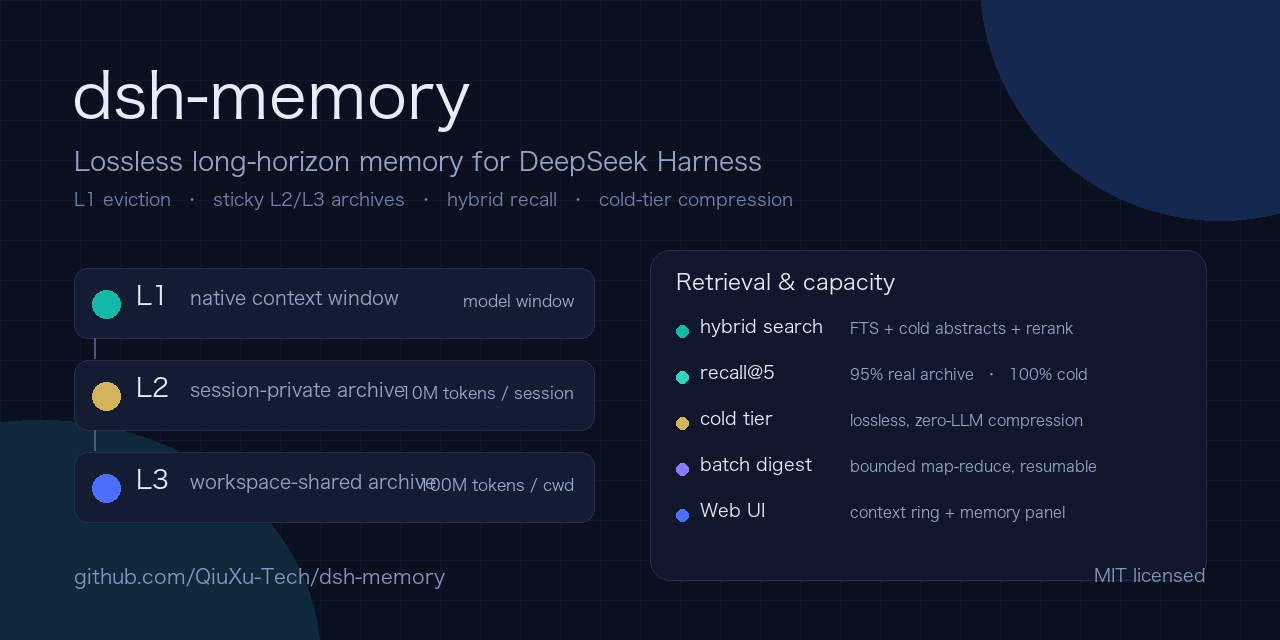
The extra-context layer for AI agents — L1 eviction, sticky L2/L3 context pools, context paging, cold-tier compression.
Extra context, not just memory
Most “memory” products are note stores or RAG indexes: you curate facts, embed them, and hope retrieval surfaces something useful. Memex starts from a different object — the model’s context window itself.
An agent’s context is scarce, volatile and ordered: tokens compete for attention, old turns get compacted or dropped, and the model can only reason over what is currently paged in. Memex treats conversation and tool history as a context hierarchy, and puts a high-performance layer between raw history and the model window.
The context hierarchy
 raw session / tool history
        │
        ├─ L1  native context window          (the model's working set)
        ├─ L2  session context pool   (10M)    private to this conversation
        ├─ L3  workspace context pool (100M)   shared across sessions in a cwd
        └─ cold context tier                   verbatim, zero-LLM spillover
- Eviction is context management, not deletion. When L1 fills, the oldest balanced span is moved out verbatim; a receipt keeps the model oriented.
- L2/L3 are sticky context pools. Once a pool is enabled it stays enabled, so context that was moved out never silently disappears.
- Paging-in can avoid re-derivation. The model can use
memory_search/memory_opento retrieve selected evidence instead of re-reading all history; finding and selecting the right evidence is not guaranteed. - Every pool is budgeted. Catalog/recall/open budgets are tuned per model family; context is injected in bounded blocks, never dumped.
Terminology: memory concepts → context concepts
| What people call it | What it actually is here |
|---|---|
| memory record | a context page (verbatim, addressable, with a “when to read” hint) |
| memory search | context lookup / candidate pages for paging-in |
| memory_open | page-in one page to the model window |
| catalog injection | context index for the current window |
| L1 eviction | context spill from the working set |
| cold tier | context swap area (lossless) |
| capacity compression | context compaction (cold spill, optional digests) |
| memory panel / context ring | context budget UI (what is hot/cold, what is shared) |
Why it is a layer, not an app
- It is window-aware. Operations are tied to the model’s context: eviction ratios, injection budgets, per-model profiles, reasoning-mode guidance.
- It is lossless before it is clever. Raw context is archived verbatim; summaries are optional and never the source of truth.
- It is automatic. No curation step: capture happens at eviction/compaction, and retrieval is driven by the model’s own tool calls or auto-recall.
- It is scoped. L2 is session-scoped and L3 is workspace-scoped; sensitive-content detection can redirect or skip detected spans, but is not a guarantee that all secrets are detected.
- It is measured. In the v0.30.0 synthetic 100M-token pool, the SQLite index was 10.7 MiB after writing and 28.3 MiB after cold spill; the measured card-field search median was 10.58 ms before and 28.33 ms after cold spill. These are shared-machine fixture results, not production guarantees (see evaluation and benchmark).
What this changes in practice
- The question is not “what facts should we store?” but “what does the model need in its window right now, and what can safely leave it?”
- The quality metric is not only recall, but context efficiency: how many tokens are spent to page in the decisive evidence, and how much context stays available without bloating the prompt.
- Missing evidence is a measurable retrieval failure, but a model may still make unsupported claims. Small live runs and pager evaluations do not establish a general hallucination-prevention guarantee.
Reading guide
- Architecture — eviction seam, pools, retrieval, compression.
- Model profiles — context budgets per model family.
- Evaluation / Benchmark — retrieval, capacity and long-horizon A/B numbers.
- Live validation — DeepSeek Flash multi-seed and tool-loop results.